

Key Insights
- AI should be evaluated by the experiences it improves—not simply the tasks it automates.
- The organizations that realize the greatest value from AI intentionally design, govern, and continuously improve employee, customer, and partner experiences.
- High AI adoption does not guarantee better business outcomes; reducing organizational friction is the better indicator of success.
- TBM enables CIOs to connect technology investments to business capabilities, stakeholder experiences, and organizational value.
- The most important AI investment decisions are no longer “What did we spend?” but “Which experiences improved, and how do we know?”
- Organizations that measure technology, experience, and business value together make better AI investment decisions than those that measure any one in isolation.
Technology no longer simply supports the business—it shapes how the business is experienced. Every application, workflow, AI copilot, intelligent agent, and digital interaction influences how employees collaborate, how customers engage, and how partners work together. These interactions determine whether technology reduces friction, accelerates decision-making, and creates value—or simply adds complexity.
Generative AI has raised both the opportunity and the stakes. Organizations are investing heavily in AI-powered assistants, intelligent workflows, and automation with the expectation that they will transform the way work gets done. While technology costs can be measured with precision, their impact on collaboration, productivity, decision quality, and customer engagement is far more difficult to demonstrate. As AI investments continue to grow, CIOs face a fundamental question: Which investments are genuinely improving the way people work, and which are simply increasing technology spend?
Technology Business Management (TBM) helps answer that question. By connecting technology investments to the business capabilities they enable, the experiences they create, and the organizational value they deliver, TBM provides executives with the transparency and decision support needed to make more informed AI investment decisions. Rather than measuring technology in isolation, mature TBM practices help leaders determine whether AI is reducing friction, improving how work gets done, and creating lasting business value.
This article explores why experience has become a strategic concern for technology leaders, why AI has made it more difficult to evaluate, and how TBM enables CIOs to intentionally design, measure, govern, and continuously improve the experiences that matter most.
Technology Is Experienced, Not Just Operated
Experience is often associated with customer satisfaction or employee engagement, but for technology leaders it represents something broader: the quality of every interaction people have with technology as they accomplish meaningful work. Every application, workflow, digital service, and AI-enabled capability either reduces friction or creates it. The cumulative effect of those interactions influences how quickly decisions are made, how effectively teams collaborate, how easily customers engage, and how productively partners work together.
This makes experience a strategic business asset rather than simply a measure of satisfaction. When technology removes unnecessary complexity, employees spend less time searching for information, switching between applications, and navigating inefficient processes. Customers resolve issues more quickly. Partners collaborate more effectively. These seemingly small improvements compound over time, strengthening productivity, innovation, resilience, and organizational performance. Research supporting the Service-Profit Chain has long demonstrated that organizations creating better employee experiences are also better positioned to improve customer outcomes and deliver stronger business results.
For CIOs, this changes how technology investments should be evaluated. Reliability, cost optimization, and operational efficiency remain essential, but they no longer provide a complete picture of success. Technology leaders must also understand which business capabilities and value streams are being improved, whose interactions with technology are changing, and whether those changes are creating measurable organizational value.
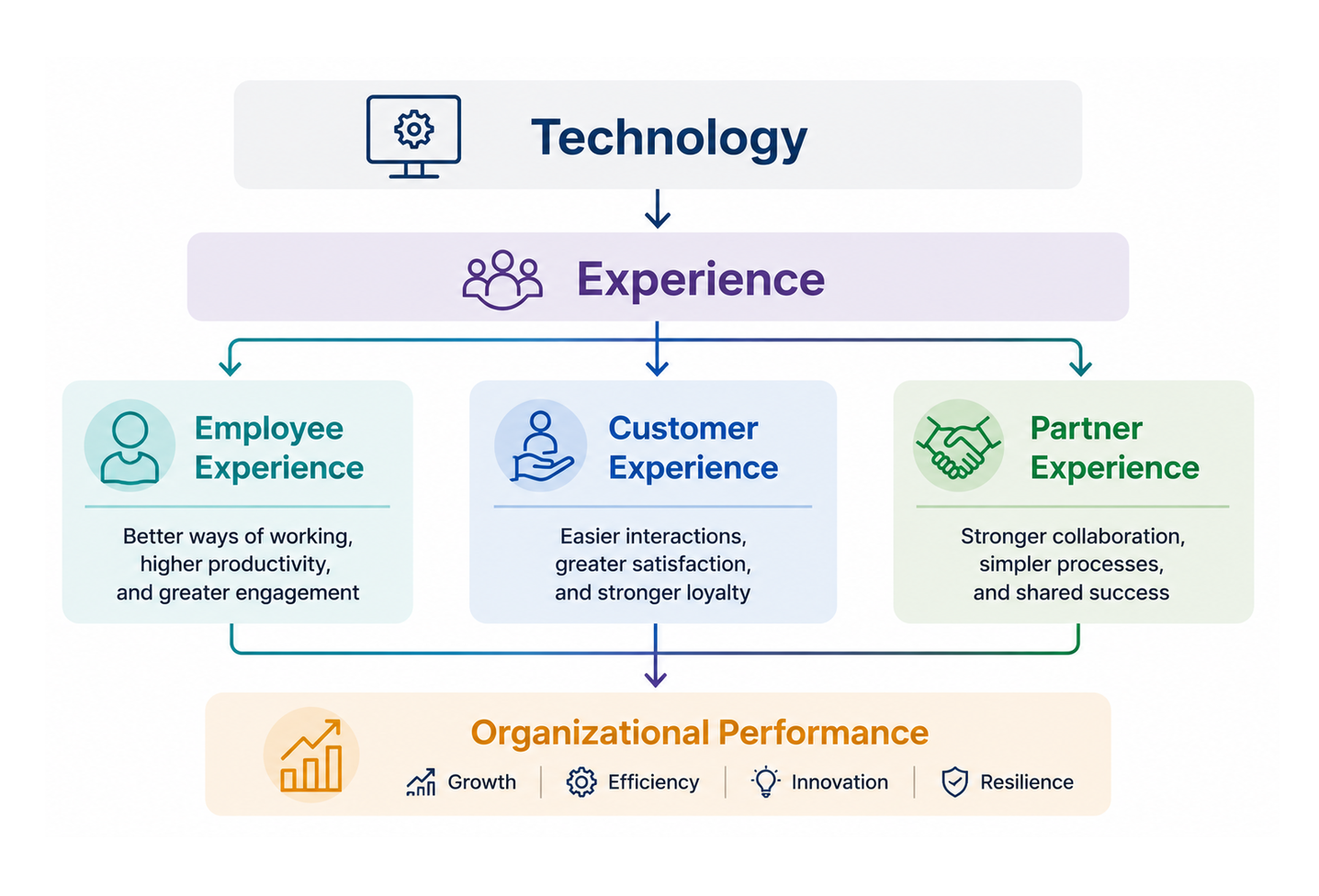
This is where TBM broadens the executive conversation. Financial transparency, cost modeling, investment planning, and standardized business views remain the foundation of a mature TBM practice. AI extends those same disciplines beyond understanding what technology costs to understanding how technology changes the way employees, customers, and partners create value. Rather than measuring technology in isolation, TBM enables executives to evaluate whether investments are reducing friction, improving the quality of work, and strengthening the experiences that ultimately drive business performance.
Generative AI has accelerated this shift. Unlike previous waves of enterprise technology, AI is not simply changing business processes—it is changing how people interact with technology itself. That makes understanding and improving experience no longer a complementary objective, but a central responsibility of technology leadership.
Generative AI Is Redefining the Experience of Work
Most technology investments expand what organizations can do. Generative AI is different because it changes how people accomplish their work. AI copilots, intelligent agents, knowledge assistants, and intelligent workflows are becoming active participants in everyday business activities—helping people discover information, generate ideas, automate routine tasks, accelerate decisions, and collaborate more effectively. In doing so, AI is fundamentally reshaping the experience of work.
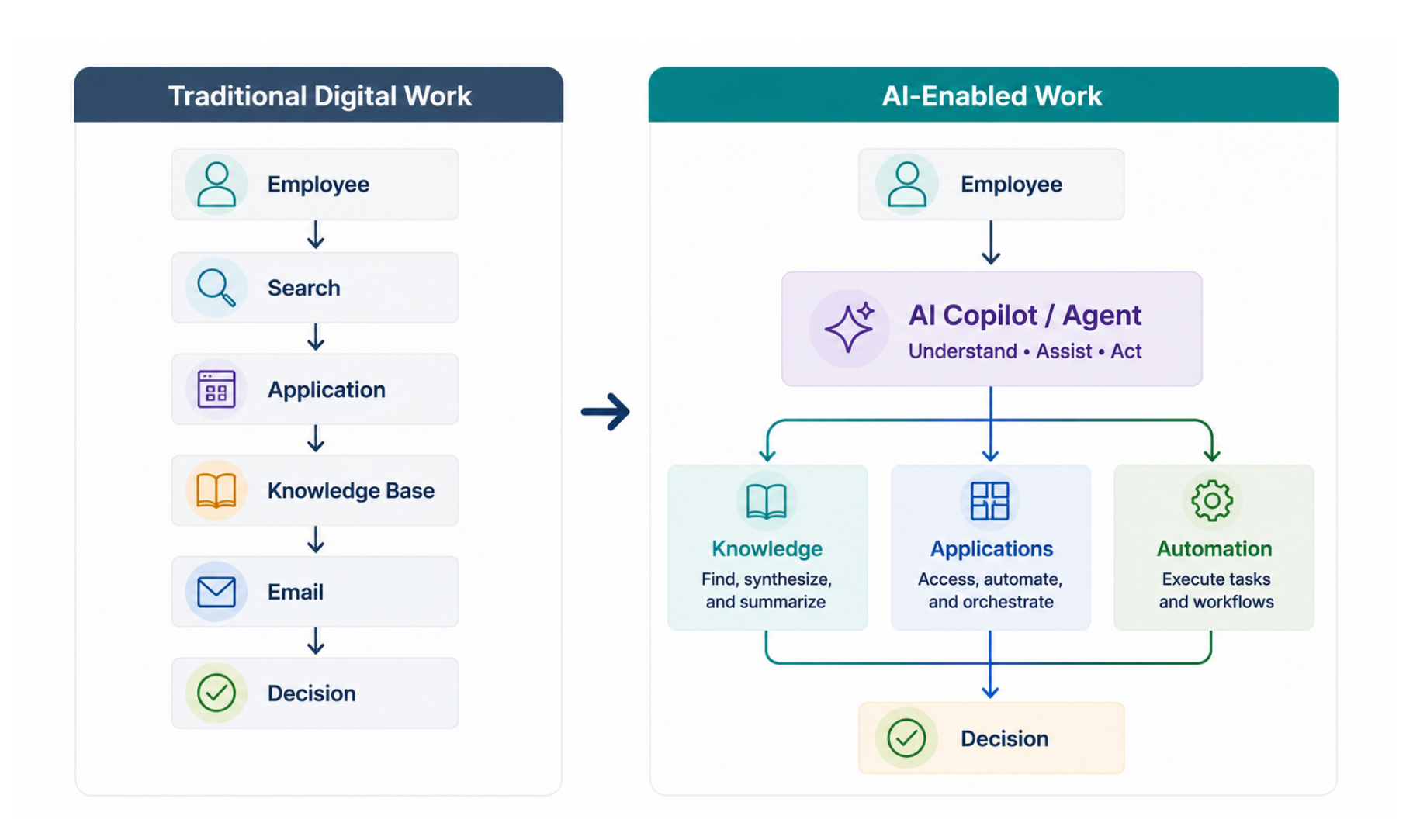
This transformation extends well beyond employee productivity. AI is changing how customers receive support, how partners interact with the organization, and how knowledge flows across the enterprise. Instead of navigating complex applications or searching through disconnected systems, people increasingly engage through natural language and AI-assisted experiences that adapt to their needs. The result is not simply greater automation, but a new way of working that reduces friction, shortens learning curves, and enables faster, more informed decisions.
For CIOs, this shift is changing the nature of executive conversations about technology investment. The question is no longer whether AI can automate individual tasks. It is whether AI is improving decision quality, accelerating innovation, strengthening customer relationships, and enabling employees and partners to create greater value. These are fundamentally questions about experience rather than technology.
This evolution also challenges the way mature TBM practices evaluate success. Traditional measures—cost, utilization, and return on investment—remain essential, but they explain only part of the story. Enterprise AI capabilities should also be evaluated by how effectively they reduce friction, improve collaboration, accelerate learning, and enhance the experiences of employees, customers, and partners. Those improvements often determine whether an AI investment delivers lasting business value, yet they are significantly more difficult to measure than technology costs alone.
Understanding why these benefits are so difficult to quantify—and why successful AI initiatives often appear to underperform in their early stages—is essential to making confident investment decisions. That challenge begins with understanding the complex relationship between experience, organizational change, and business value.
Why Experience Is Difficult to Measure
If experience has become one of the most important outcomes of technology investment, why is it so difficult to measure?
The answer is that experience behaves differently than cost. Technology costs are immediate, visible, and relatively easy to allocate. Organizations can confidently measure software licensing, cloud infrastructure, implementation services, and labor. The benefits of AI, however, often emerge gradually as people adopt new ways of working, redesign business processes, and build confidence in AI-assisted decisions. Improvements such as faster onboarding, reduced context switching, stronger collaboration, or better customer interactions rarely appear as clearly on a financial report.
Research helps explain why this disconnect exists. Economist Erik Brynjolfsson has observed that transformative technologies often follow a productivity J-curve, where organizations invest well before complementary changes in skills, workflows, and operating models produce measurable gains. Likewise, research by Fabrizio Dell’Acqua and colleagues has shown that generative AI produces highly uneven results across different tasks, meaning broad utilization or adoption metrics rarely reflect where meaningful value is actually being created. Organizations that introduce AI without redesigning work can also create new sources of organizational friction—a challenge increasingly described as cultural debt.
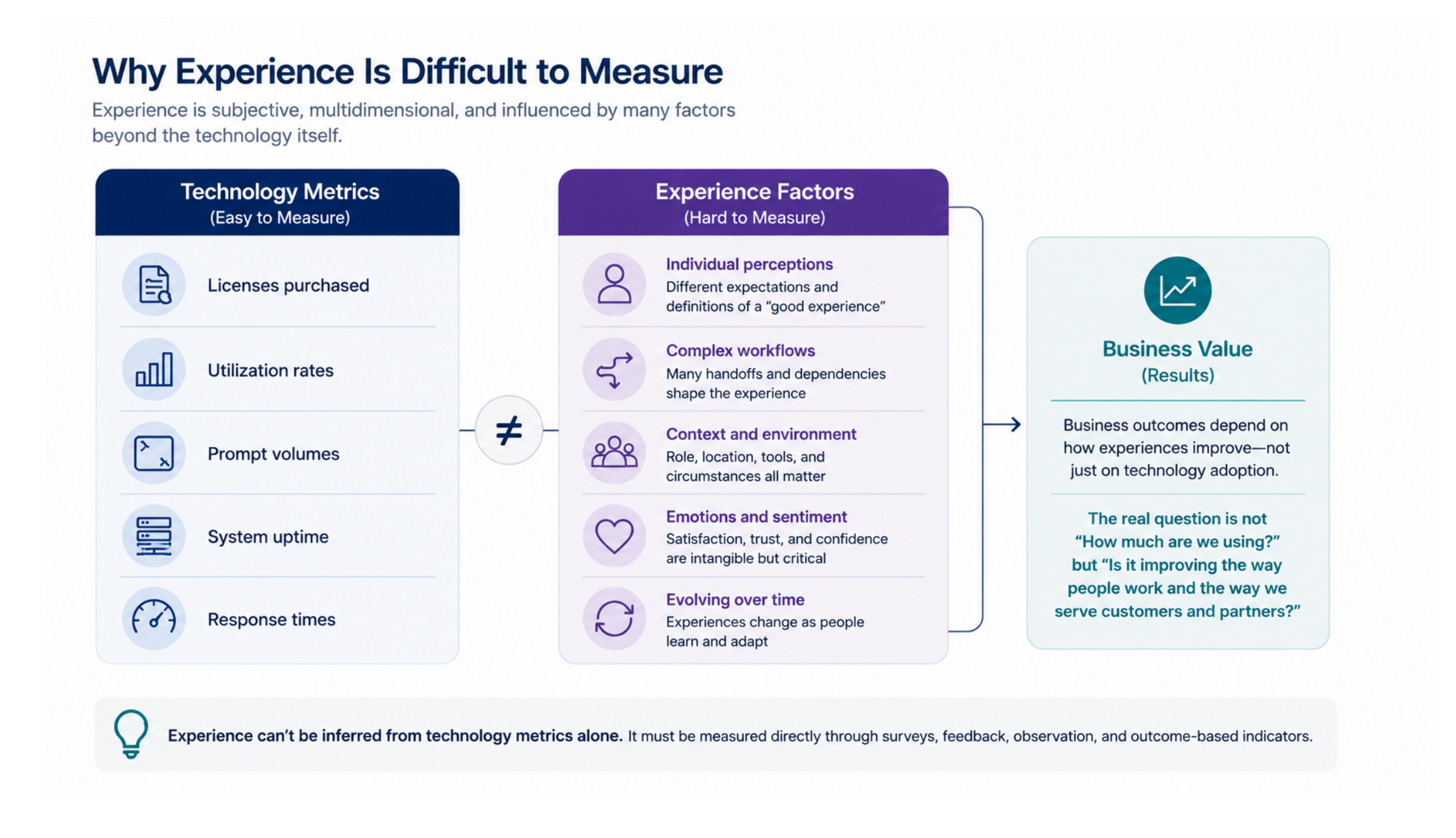
For CIOs, these realities create a difficult leadership challenge. An AI copilot may be widely adopted without improving decision quality. An intelligent workflow may reduce processing time while increasing employee frustration. A business unit may report exceptional results while another realizes little measurable benefit from the same technology. Traditional technology metrics cannot explain these differences because they measure deployment rather than impact.
This is where the executive conversation begins to change. Measuring technology is no longer enough. Leaders must determine whether AI is improving the way employees, customers, and partners accomplish meaningful work—and whether those improvements are creating measurable organizational value. Doing so requires connecting technology investments to business capabilities, the experiences they influence, and the outcomes they enable.
That is precisely where mature TBM practices provide a distinct advantage. By combining financial transparency with business context, operational insight, and investment analysis, TBM gives executives the information needed to move beyond measuring technology consumption toward understanding how AI investments create value through better experiences.
Using TBM to Guide AI Investment Decisions
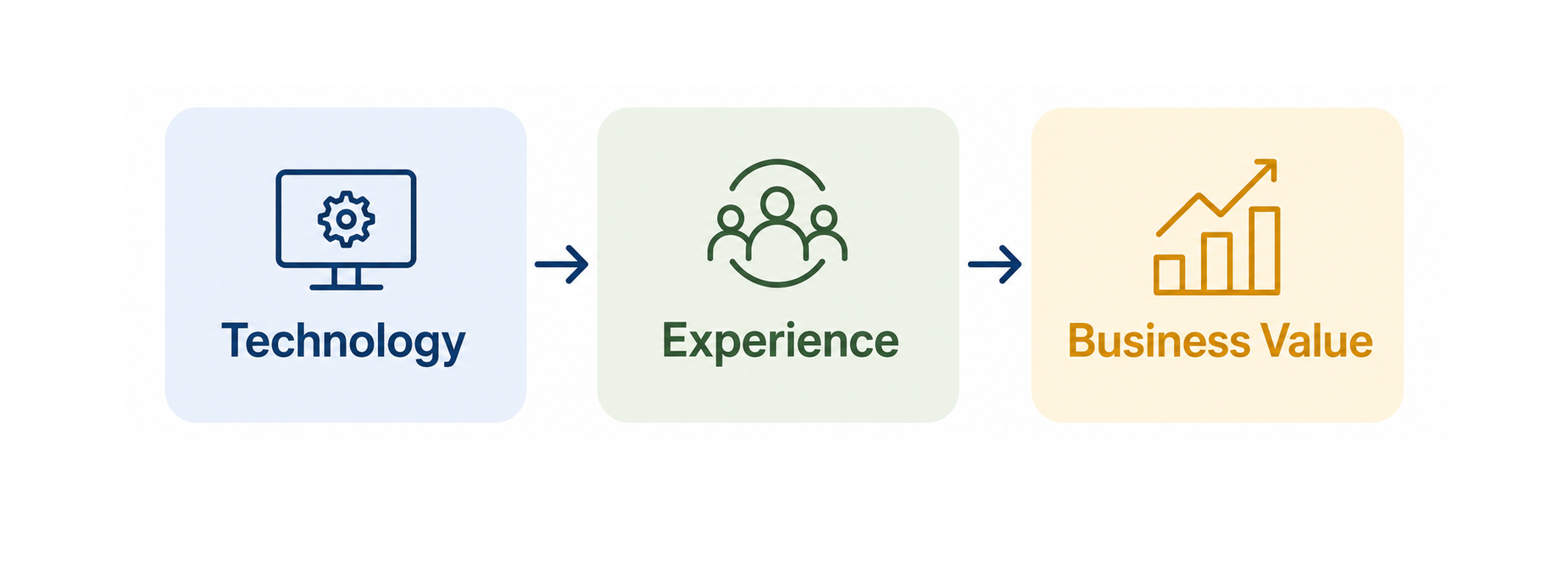
AI has fundamentally changed the relationship between technology investment and business value. Traditional technology investments were often evaluated through cost, utilization, and technical performance. Those measures remain essential, but they tell only part of the story. AI creates value by changing how people work, collaborate, and make decisions. In other words, technology enables experiences, and improved experiences create business value. The role of TBM is to help executives understand—and manage—that progression.
Which experiences should we improve first? Every organization has more opportunities to apply AI than it has budget, talent, or organizational capacity to pursue. Rather than beginning with available AI technologies, CIOs should begin by identifying where employees, customers, or partners encounter the greatest friction. Which decisions take too long? Which workflows require unnecessary manual effort? Where do knowledge gaps slow execution? Using the TBM taxonomy and cost model, organizations can trace AI investments from infrastructure, software, and shared services through the applications, business capabilities, and value streams they support. This gives executives a common decision model for comparing AI opportunities based on both their total investment and the organizational experiences they are expected to improve.
What investment are we really making? AI licenses are only one component of the total cost. Successful AI capabilities also require cloud infrastructure, integration, security, governance, organizational change, user training, prompt engineering, and ongoing operational support. Without understanding these interconnected costs, organizations can significantly underestimate the investment required to improve the way people work. TBM cost models expose the full cost of delivering AI-enabled business capabilities, allowing executives to compare competing initiatives using a consistent financial model rather than isolated business cases. This creates better trade-offs between competing priorities before additional resources are committed.
Is work actually getting better? High adoption does not necessarily indicate high value. An AI copilot may be used thousands of times each day while employees continue to struggle with fragmented workflows, duplicated effort, or time spent validating AI-generated responses. Mature TBM practices encourage executives to evaluate AI alongside measures such as faster onboarding, reduced context switching, improved collaboration, shorter decision cycles, higher first-contact resolution, or reduced customer effort. These indicators reveal whether AI is genuinely reducing friction and improving the quality of work rather than simply increasing technology consumption.
Should we scale—or stop? AI rarely produces consistent results across an enterprise. A customer service organization may achieve dramatic improvements while a finance team realizes only marginal benefits from similar AI capabilities. Because TBM maps investments to common business capabilities and value streams, executives can compare outcomes across organizational boundaries to understand where AI is creating measurable value and why. Those insights help distinguish successful operating models from successful technology deployments, allowing leaders to scale successful initiatives, redesign those with unrealized potential, and retire investments that fail to improve organizational performance.
Ultimately, TBM changes the executive conversation. Instead of asking, “What did we spend?” or “How many people are using AI?”, leaders can begin asking “Which experiences are improving?”, “Where is AI creating measurable business value?”, and “What should we do next?” Those are fundamentally different questions—and they require a fundamentally different use of TBM.
Even the best investment decisions, however, cannot guarantee better experiences. AI capabilities continue to evolve after deployment as people adapt, workflows change, and business priorities shift. Sustaining long-term value therefore requires more than informed investment decisions; it requires governing the experiences AI creates over time.
Governing Experience
Consider two business units that deploy similar AI copilots. Both achieve strong adoption, yet one reports faster decisions, higher employee satisfaction, and improved customer outcomes while the other struggles with inconsistent usage, growing frustration, and little measurable business impact. The difference is rarely the technology alone. It is how the organization introduces, supports, and continuously improves the experiences surrounding that technology.
This is why governing experience has become a strategic responsibility for CIOs. Selecting the right AI investments is only the beginning. The way employees, customers, and partners interact with those capabilities will continue to evolve as business priorities shift, AI technologies mature, and organizations discover better ways of working. Experience is not a one-time outcome of deployment—it is an organizational capability that must be intentionally managed over time.
One of the greatest risks is the gradual accumulation of organizational friction. AI can reduce repetitive work and accelerate decisions, but poorly implemented capabilities can also increase context switching, require constant validation of AI-generated content, create uncertainty about when human judgment is required, or contribute to employee burnout through unrealistic expectations of always-on productivity. Over time, these unintended consequences can become a form of cultural debt, where technology designed to simplify work instead increases complexity, erodes trust, and slows adoption.
Effective governance therefore extends beyond technology oversight. It requires organizations to continually evaluate how work is changing, where new sources of friction are emerging, and whether AI continues to improve the experiences it was intended to enhance. This makes organizational change management an ongoing discipline rather than a deployment activity. Communication, education, workflow redesign, and continuous feedback become just as important as technical implementation.
No single executive can govern experience alone. CIOs bring expertise in technology strategy, data, and investment planning. Business leaders understand operational outcomes and changing customer expectations. CHROs contribute expertise in workforce readiness, organizational development, and employee well-being. Together, these perspectives help organizations balance innovation with sustainable ways of working, ensuring AI strengthens organizational performance without diminishing the people who create it.
For mature TBM practices, governance creates a continuous feedback loop between investment decisions and organizational outcomes. Financial transparency, operational measures, and experience indicators allow leaders to detect emerging friction, compare results across business capabilities and value streams, and refine AI investments before small issues become systemic barriers. Governance becomes less about controlling technology and more about continuously improving the experiences through which technology creates value.
The final step is ensuring that these improvements can be demonstrated consistently. To govern experience effectively, organizations must also measure it in a way that connects technology investments to organizational performance—a challenge that requires looking beyond traditional technology metrics alone.
Measuring What Matters
Governing experience requires more than intuition. It requires evidence that AI investments are changing the way people work and that those changes are creating measurable organizational value. Yet many organizations focus almost exclusively on technology metrics—licenses assigned, prompts submitted, or utilization rates—while overlooking whether AI is improving the experiences those investments were intended to create.
A more complete measurement strategy answers three executive questions.
| Measure | Primary Question | Example Metrics |
| Technology Measures | Are we delivering AI efficiently? | Cost per user, cost per AI interaction, utilization, consumption, infrastructure cost, model operating cost |
| Experience Measures | Is AI improving the way people work and interact? | Time-to-productivity, digital friction, AI-assisted task completion, Customer Effort Score (CES), collaboration effectiveness |
| Business Measures | Are those improved experiences creating measurable organizational value? | Productivity, Customer Satisfaction (CSAT), employee retention, innovation, operational efficiency, revenue growth |
Each category provides a different perspective on AI performance. Technology measures help executives understand the investment required to deliver AI capabilities. Experience measures reveal whether those capabilities are reducing friction and improving the quality of interactions for employees, customers, and partners. Business measures determine whether those improvements are contributing to broader organizational outcomes. The greatest insight comes from understanding how these three perspectives influence one another rather than evaluating each in isolation.
Measuring Experience Across the Enterprise
Every AI initiative should identify whose experience it is intended to improve before success is measured. While the specific metrics will vary by organization and use case, the following examples illustrate how executives can align AI investments with the experiences they are intended to improve.
| Experience | Example KPIs | Executive Insight |
| Employee Experience | Time-to-productivity, Employee Net Promoter Score (eNPS), AI-assisted task completion rate | Are employees spending less time on routine work, making better decisions, and creating more value? |
| Customer Experience | Customer Satisfaction (CSAT), Customer Effort Score (CES), First Contact Resolution | Is AI making it easier for customers to engage with the organization and achieve successful outcomes? |
| Partner Experience | Partner response time, Self-service completion rate, Partner satisfaction | Is AI reducing friction and strengthening collaboration across the broader business ecosystem? |
For mature TBM practices, these measures form a connected chain of evidence rather than separate scorecards. TBM links technology investments to the applications, business capabilities, and value streams they enable. Those capabilities shape the experiences of employees, customers, and partners. Those experiences ultimately influence organizational performance.
Viewed through this progression, no single metric can determine whether an AI investment is successful. High utilization does not guarantee better ways of working. Improved employee or customer experiences do not automatically translate into stronger business performance. Only by measuring all three perspectives together can executives understand where AI is creating value, where additional investment or organizational change is needed, and where expectations should be reconsidered.
This integrated view is what allows TBM to move beyond measuring technology costs. It enables CIOs to evaluate AI as a strategic business investment—one whose success is determined not simply by what the technology does, but by the experiences it creates and the organizational value those experiences enable.
Conclusion
Generative AI has fundamentally changed the expectations placed on technology leadership. Success is no longer defined solely by reliable operations, cost optimization, or successful deployments. Increasingly, CIOs are expected to demonstrate that technology investments are improving how employees work, how customers engage, and how partners collaborate. In the age of AI, experience has become a strategic measure of business value.
Meeting that expectation requires a broader approach to Technology Business Management. The financial transparency, cost modeling, investment planning, and scenario analysis that define mature TBM practices remain indispensable, but they are no longer sufficient on their own. CIOs must also understand how technology investments influence business capabilities, reshape day-to-day interactions, and ultimately contribute to organizational performance. Experience has become the missing connection between technology investments and the business value they are intended to create.
This represents an opportunity for both CIOs and TBM practitioners. Rather than viewing AI as another technology to deploy, they can use TBM to ask better questions: Which experiences should we improve first? Where is AI reducing friction and enabling better decisions? Which investments deserve to scale, and which should be redesigned or retired? Those questions shift executive conversations away from technology consumption and toward organizational outcomes.
As AI capabilities continue to evolve, the organizations that realize the greatest value will not necessarily be those that deploy the most technology. They will be the ones that most intentionally design, measure, govern, and continuously improve the experiences technology creates. By connecting technology investments to business capabilities, stakeholder experiences, and organizational value, TBM gives executives the insight to make that possible.
The next time your organization reviews its AI portfolio, ask one question before approving the next investment: Which experiences are we improving, and how will we know? If that answer cannot be supported with confidence, the opportunity is not to invest in more AI—it is to use TBM to better understand how technology creates value through the experiences of employees, customers, and partners.


