

- Treat Operational Efficiency as a continuous leadership discipline—not a cost-reduction initiative or periodic optimization program.
- Evaluate technology decisions as part of an interconnected operating system, because optimizing individual technologies rarely optimizes organizational performance.
- Use TBM to establish a shared operational understanding that enables Technology, Finance, and business leaders to make better decisions together.
- Institutionalize Operational Efficiency through continuous improvement, organizational alignment, and governance rather than relying on isolated transformation projects.
- Measure Operational Efficiency by how effectively it improves the organization’s ability to adapt, execute strategy, and respond to changing business priorities.
Why Operational Efficiency Matters More Than Ever
Technology organizations have reached a point where complexity is growing faster than our ability to manage it. Cloud platforms, AI services, cybersecurity, SaaS applications, product operating models, and expanding vendor ecosystems have transformed enterprise technology into an interconnected operating environment where decisions in one area routinely influence many others. As complexity increases, improving technology operations becomes less about working harder or spending less—and more about making consistently better decisions.
This shift has fundamentally changed the role of Operational Efficiency. It is no longer simply an internal objective for reducing cost or improving utilization. It has become a leadership discipline that enables organizations to continuously improve technology operations while adapting to changing business priorities. Organizations that excel at Operational Efficiency do not eliminate complexity. They develop the capability to understand it, manage it, and improve technology operations despite it.
Technology Business Management (TBM) provides the management system that makes this possible. By connecting financial transparency with operational context, shared taxonomy, governance, and business outcomes, TBM enables leaders to move beyond isolated optimization initiatives toward a repeatable management discipline for continually improving technology operations. Instead of asking only “What does technology cost?” leaders begin asking, “How can technology operate better tomorrow than it does today?”
This paper explores how that transformation occurs. It examines why Operational Efficiency must be viewed differently in today’s technology environment, how leaders evaluate technology as a connected system, how TBM creates the shared understanding needed for better decisions, how those decisions become a continuous cycle of operational improvement, how organizations sustain those improvements through alignment, and how Operational Efficiency enables organizations to continually support evolving business priorities.
Operational Efficiency is ultimately not measured by how much cost an organization removes from technology. It is measured by how consistently leaders improve the way technology operates—enabling the organization to adapt with confidence, execute strategy more effectively, and continually improve its ability to meet whatever challenges come next.
Operational Efficiency Is More Than Cost Reduction
For many organizations, Operational Efficiency has become synonymous with cost reduction. When budgets tighten, technology leaders freeze hiring, renegotiate vendor contracts, retire applications, defer modernization, or reduce discretionary spending—all in pursuit of becoming more efficient. While these actions may reduce expenses, they rarely improve the organization’s ability to deliver technology services, respond to changing business priorities, or create lasting business value.
This reflects a fundamental misunderstanding. Cost reduction is a financial outcome. Operational Efficiency is the discipline of continually improving technology operations.
That distinction changes the purpose of operational improvement. The objective is no longer to spend less—it is to make technology easier to operate, manage, and evolve. Simplifying an application portfolio should reduce operational friction. Improving cloud governance should increase resource utilization. Automating repetitive work should improve consistency and free technical talent for higher-value activities. Strengthening service ownership should improve accountability and decision-making. Lower costs may follow, but they are the consequence of improving technology operations—not the objective.
Technology leaders should therefore evaluate Operational Efficiency differently. Rather than asking, “How much money did this initiative save?”, they should begin with a more valuable question:
“How has this initiative improved the way our technology organization operates?”
The answer should be visible through measurable operational improvements: simpler technology environments, faster delivery, stronger resilience, improved service quality, better resource utilization, or more effective engineering teams. If an initiative cannot demonstrate that technology operations have improved, Operational Efficiency has not improved either, regardless of its financial impact.
TBM enables this broader perspective by connecting technology investments with operational activities, services, consumption, and business outcomes into a common management view. Instead of evaluating individual projects or technologies in isolation, leaders can understand how proposed improvements influence the performance of the technology organization as a whole. Financial transparency remains essential, but it becomes the beginning of Operational Efficiency rather than its destination.
Operational Efficiency is not achieved through occasional optimization projects. It develops through the continuous improvement of technology operations. Every operational improvement should therefore be evaluated twice: before implementation, by defining how it will improve technology operations, and after implementation, by measuring whether those improvements were actually achieved. This transforms Operational Efficiency from a periodic budgeting exercise into an ongoing management discipline.
As organizations improve the way technology operates, an important outcome begins to emerge. Technology environments become simpler to manage. Engineers spend less time maintaining unnecessary complexity and more time delivering new capabilities. Leadership attention shifts from resolving operational issues toward advancing strategic priorities. Operational Efficiency creates organizational capacity—but that capacity is the result of better technology operations, not the objective itself.
Technology leaders can assess whether Operational Efficiency is improving by asking:
- Has this initiative made technology simpler to operate, manage, or change?
- Can we demonstrate measurable improvements in operational performance?
- Are teams spending less effort maintaining unnecessary complexity?
- Do these operational improvements strengthen the organization’s ability to execute its business strategy?
Organizations that consistently answer “yes” to these questions are no longer managing Operational Efficiency as a cost-reduction program. They are developing it as a continuous management discipline.
If Operational Efficiency depends on continually improving technology operations, why do so many organizations struggle to achieve it? The answer is not a lack of investment or expertise. It is that today’s technology environments have become too interconnected to understand—and therefore improve—through intuition alone.
Complexity Has Changed the Rules of Technology Management
Technology organizations have not become less capable over the past decade—they have become far more interconnected. Every significant technology investment, whether a cloud platform, AI capability, SaaS application, cybersecurity control, or digital product, creates new operational relationships that leaders must understand and govern. Technology environments no longer behave as collections of independent technologies; they behave as connected systems where changes in one area routinely influence many others. Continually improving technology operations has therefore become fundamentally more difficult.
For today’s CIO, this represents a fundamental shift in technology leadership. Operational Efficiency is no longer constrained primarily by effort or expertise. It is constrained by the organization’s ability to make informed decisions within an increasingly interconnected technology environment. Technology leaders should therefore assume that every meaningful operational improvement will influence multiple parts of the organization, even when those relationships are not immediately visible.
A cloud migration, for example, is no longer simply an infrastructure initiative. It influences application architectures, vendor contracts, cybersecurity controls, financial planning, labor models, sustainability objectives, and customer-facing services. Rationalizing an application portfolio may reduce licensing costs while increasing cloud consumption or expose technical dependencies elsewhere. Accelerating AI adoption may improve productivity while introducing new governance requirements, infrastructure demand, and operational risk. Every major technology initiative should therefore be evaluated according to the relationships it changes—not merely the technology it changes.
This challenge reflects a principle long recognized in Systems Thinking: improving individual components does not necessarily improve the performance of the whole. Leaders who optimize one technology domain at a time may improve local performance while unintentionally reducing overall organizational effectiveness. The effectiveness of a technology decision is therefore determined less by how well it improves one domain than by how well it improves the technology system as a whole.
Understanding that technology behaves as a connected system is only the first step. The practical challenge is making better decisions because of that understanding. Every significant technology initiative should therefore undergo a Whole-System Review before implementation.
Rather than asking whether an initiative benefits a single technology domain, leaders should evaluate it across five connected perspectives:
- Technology — What technical dependencies or architectures will change?
- Operations — How will services, engineering, or operational processes be affected?
- Finance — How will costs, consumption, or investment priorities change?
- Risk — What cybersecurity, compliance, or resilience implications will emerge?
- Business — How will business capabilities, customer outcomes, or strategic priorities be influenced?
The objective is not to complete five independent assessments. It is to understand how those perspectives influence one another before making a decision. Only after those relationships and trade-offs are understood should implementation decisions be made.
Figure 2.1 — The Whole-System Review
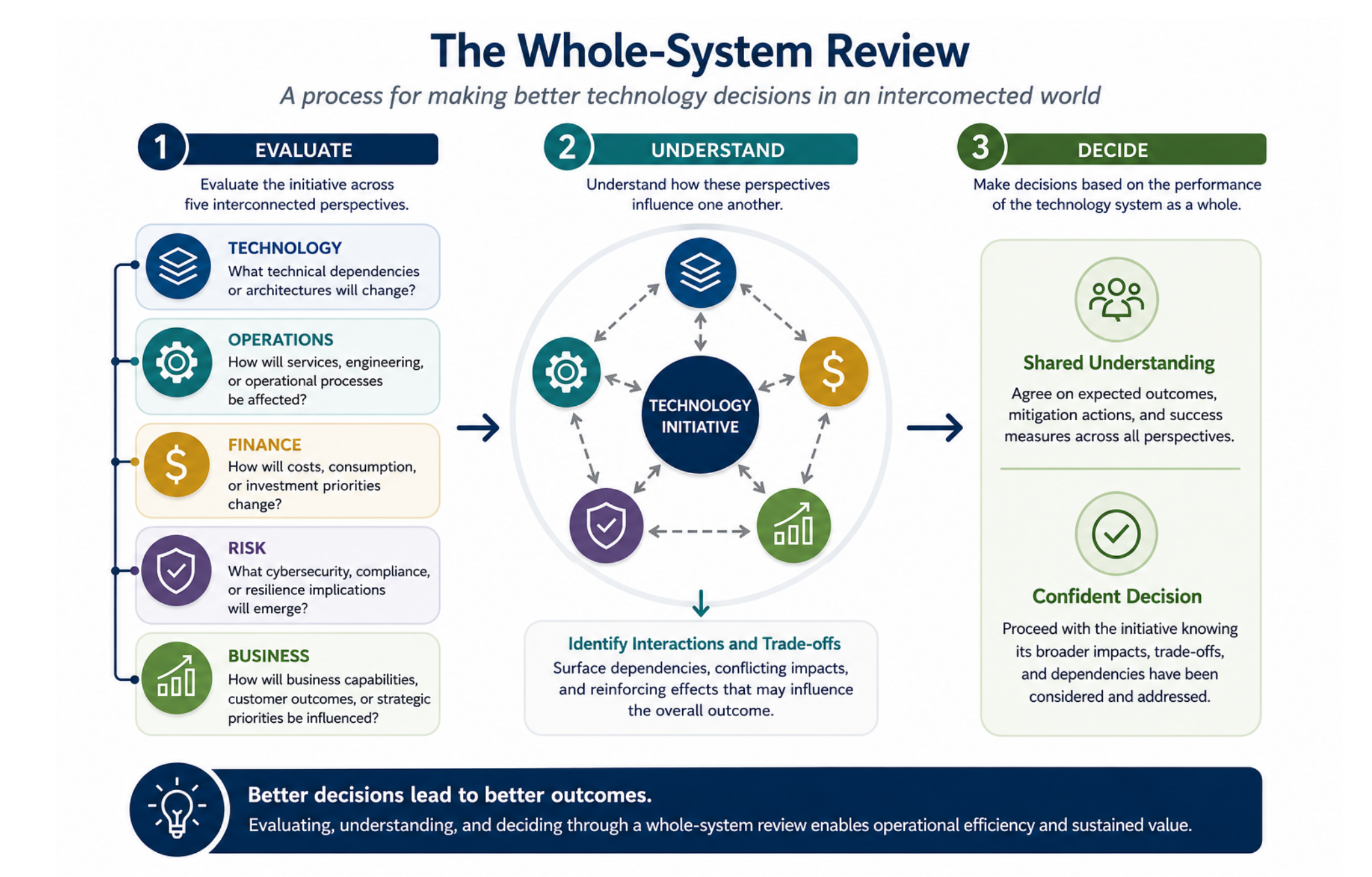
TBM enables this review by providing the shared understanding needed to evaluate relationships across the technology system before decisions are made. By connecting financial information, operational data, technology resources, services, and business capabilities into a common management view, leaders gain the context needed to anticipate operational consequences rather than discovering them after implementation. Complexity becomes something that can be understood and deliberately managed instead of simply endured.
Cloud services evolve continuously. AI capabilities mature rapidly. Product teams deliver new functionality in weeks rather than years, while technical debt quietly accumulates through thousands of incremental decisions. Operational Efficiency therefore requires more than periodic optimization initiatives. It requires the continual ability to make informed decisions, improve technology operations, and adapt as the technology environment evolves.
Operational Efficiency ultimately depends not on simplifying technology, but on continually improving an increasingly interconnected technology system through better decisions. That raises the next question: how do organizations develop the shared understanding required to make those decisions with confidence?
Seeing Technology Operations as a Connected System
The Whole-System Review introduced in the previous section depends on one essential capability: leaders throughout the organization must begin from the same understanding of how technology operates. Without that foundation, technology, finance, engineering, architecture, operations, and business leaders may evaluate the same initiative differently, making consistent decision-making nearly impossible. This is the management challenge that TBM was created to solve.
Organizations improve Operational Efficiency by building a management model that reflects how technology actually operates rather than how organizational charts divide responsibility. Instead of managing infrastructure, applications, cloud platforms, finances, and business services as separate domains, they manage the relationships between them. Complexity becomes a question of understanding relationships rather than managing individual technologies.
TBM provides that management model by integrating financial, operational, and business perspectives into a unified view of the technology organization. It enables technology, finance, engineering, and business leaders to work from the same operational foundation, producing more consistent operational decisions.
Financial transparency is the starting point because leaders cannot improve what they cannot accurately measure. Yet cost alone rarely explains operational performance or where improvement opportunities exist.
TBM extends financial transparency by connecting cost with operational signals, consumption patterns, service relationships, and business context. Together these perspectives explain not only where resources are invested, but how effectively they support business outcomes.
Creating this perspective requires more than connected data—it requires a common language.
When teams classify applications differently, define services inconsistently, or organize technology costs through incompatible structures, they make decisions from different assumptions. Even abundant information loses value when it cannot be interpreted consistently.
TBM addresses this challenge through a standardized technology taxonomy. Shared definitions connect financial records, operational metrics, technology assets, services, and business capabilities into a coherent operating model. Without shared definitions, every operational review begins from a different understanding of reality.
A common management model also allows specialized disciplines to reinforce one another. FinOps, Enterprise Architecture, IT Service Management, Strategic Portfolio Management, cybersecurity, and product operating models each contribute valuable insight, but none provides a complete picture alone.
TBM connects these disciplines into a single management system, replacing competing interpretations of technology performance with a trusted operational view. Leaders gain the context needed to evaluate trade-offs, anticipate downstream impacts, prioritize investments, and conduct effective Whole-System Reviews.
The purpose of this connected understanding is not simply to produce better information—it is to produce better operational decisions. Leaders should judge the effectiveness of their management system not by the volume of information it generates, but by whether it consistently improves technology decisions.
You know this foundation is taking hold when executive discussions spend less time debating technology facts and more time evaluating trade-offs. Different teams reach similar conclusions from the same operational data, and decisions become faster because participants share a common understanding of technology performance.
Connected information becomes informed decisions. Informed decisions become continuous operational improvement. Continuous operational improvement becomes a repeatable management discipline.
From Understanding to Continuous Improvement
The previous section established that TBM creates the common operational understanding required for better technology decisions. That understanding, however, has little value on its own. Operational Efficiency improves only when organizations repeatedly transform that understanding into operational action. Better information does not create better outcomes. Better decisions—made consistently over time—do.
This distinction separates organizations that simply report technology performance from those that continuously improve it. Many organizations treat transparency as the endpoint of a TBM program, producing dashboards, reports, and metrics that describe the current state of the technology environment. High-performing organizations treat transparency as the beginning of a management discipline. Every insight should lead to a decision, every decision to an operational improvement, and every improvement should create the next opportunity for learning.
That shift changes the purpose of executive reviews. Rather than using reports to explain current performance, leaders use them to identify the next operational decision.
| Organizations Beginning the Journey | Organizations Practicing Continuous Operational Improvement |
| What does this technology cost? | How effectively is this technology operating? |
| Where are we overspending? | What operational decision will remove the greatest operational friction? |
| Which services consume the most resources? | Which improvement will create the greatest organizational value? |
| How do we compare to our peers? | What decision should we make before our next review? |
Executive reviews stop measuring performance and begin driving improvement. Reports become valuable not because they explain the past, but because they guide the next operational decision.
This philosophy closely reflects Kaizen, which emphasizes continuous improvement through many small, deliberate changes rather than occasional large transformations. Operational Efficiency develops the same way. Leaders should therefore favor frequent operational improvements over waiting for transformational initiatives. Small improvements compound into significant gains in operational performance.
Continuous improvement also changes how organizations think about information quality. Leaders rarely possess perfect information before making a decision, nor should they wait until they do. Make the best operational decision possible using today’s understanding, then use tomorrow’s results to improve the next decision. Progress comes from shortening the learning cycle—not eliminating uncertainty.
The Operational Intelligence Cycle provides a practical management discipline for applying this philosophy.
Figure 4.1 — The Operational Intelligence Cycle
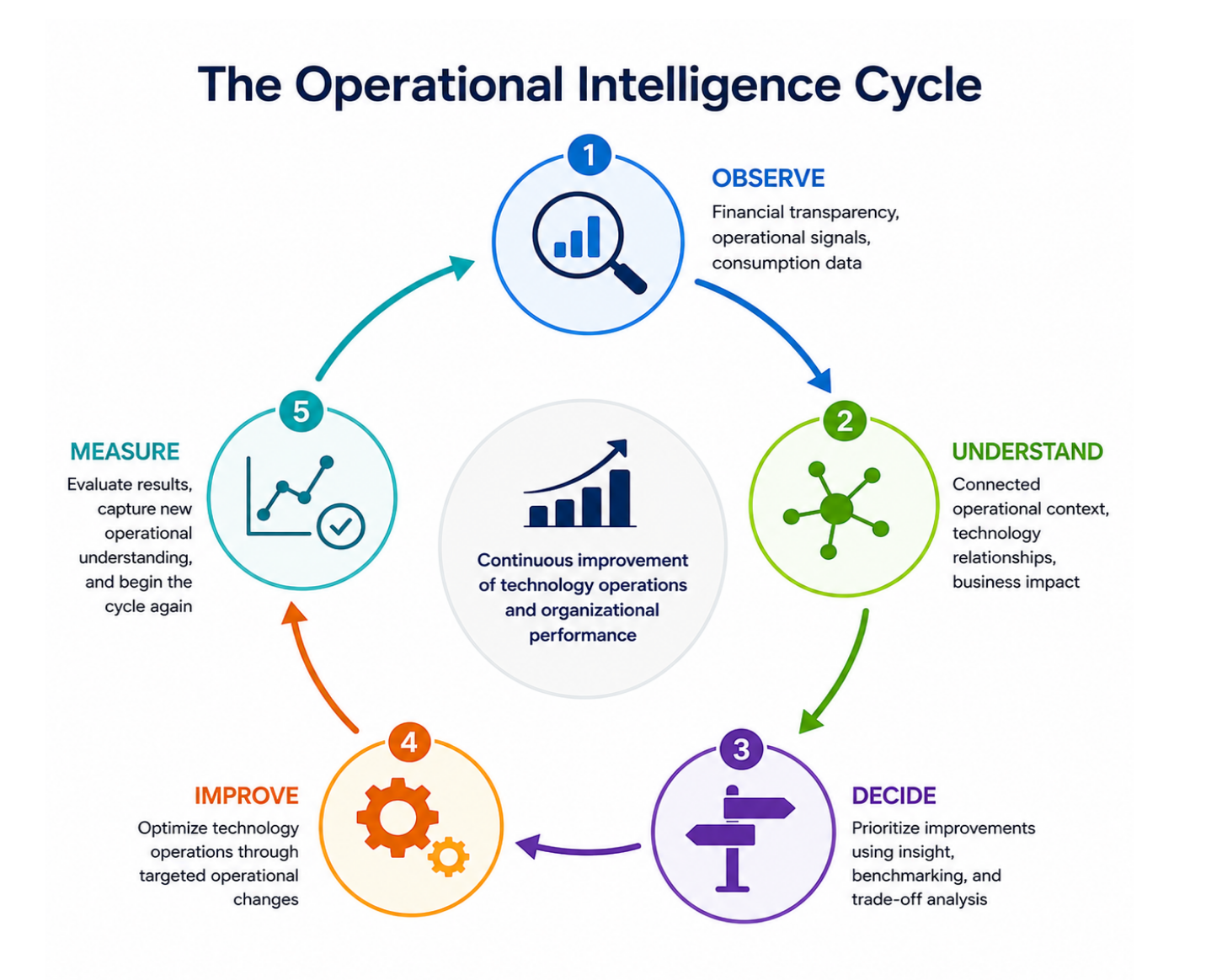
The purpose of this decision process is not to standardize analysis—it is to standardize how operational decisions are made. Every significant operational review should move through the cycle, producing at least one deliberate operational improvement before beginning again. Organizations that repeat this discipline continuously adapt to changing technology demands. Those that reserve it for annual planning or budget cycles inevitably struggle to keep pace with the rate of technological change.
Organizations do not become operationally efficient because they complete this cycle once. They become operationally efficient because this way of making decisions becomes their normal approach to managing technology.
Sustaining Operational Efficiency Through Organizational Alignment
Once organizations establish a repeatable decision discipline, the next challenge is ensuring that operational improvements endure. Many technology initiatives achieve their immediate objectives yet fail to produce lasting Operational Efficiency because they optimize individual initiatives without evaluating their effect on the operating environment as a whole.
Technology organizations naturally divide responsibility across specialized disciplines. Infrastructure teams manage platforms. Application teams manage software portfolios. Security manages organizational risk. Enterprise Architecture governs technology standards. Finance manages costs. Each function may improve its own area, yet Operational Efficiency depends on leaders managing the relationships between these disciplines rather than allowing each to optimize independently.
This principle has long been recognized in organizational research. The Nadler–Tushman Congruence Model argues that organizational performance depends on the degree to which work, people, organizational structures, culture, and incentives reinforce one another. Improving one element while neglecting the others often shifts operational problems rather than eliminating them.
Figure 5.1 — The Nadler–Tushman Congruence Model
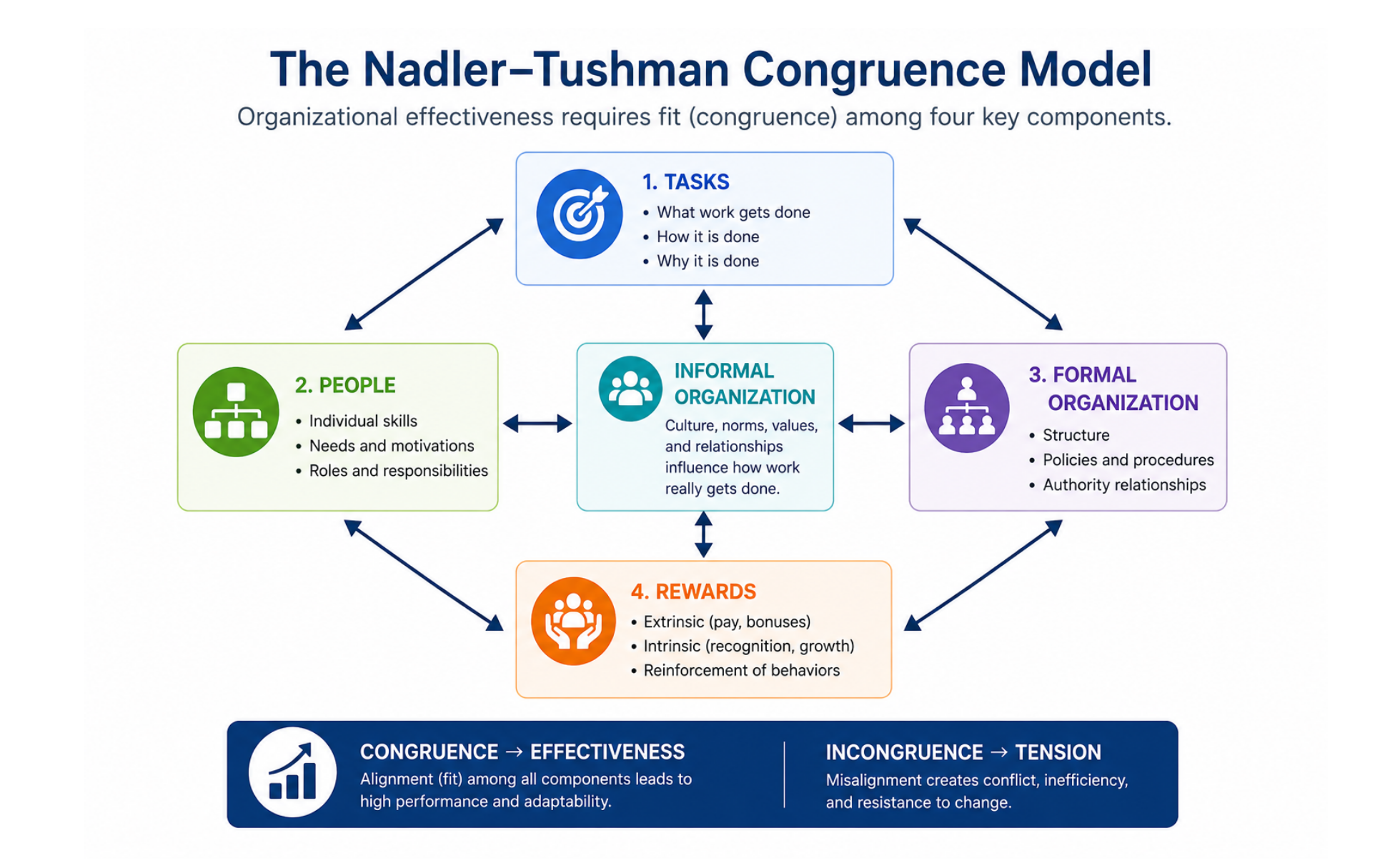
Technology organizations experience these same dynamics. A cloud migration may reduce infrastructure costs while increasing application complexity. Modernizing an application may improve customer experience while introducing new operational support requirements. Strengthening cybersecurity may reduce organizational risk while increasing friction for engineering teams. Every significant operational improvement should therefore be evaluated for its downstream effects before implementation.
Before approving any significant operational initiative, leaders should ask a simple question:
Will this initiative strengthen or weaken the alignment of the operating environment as a whole?
Alignment is not simply an outcome to observe—it should become a standard approval criterion for every major operational decision.
This is where the Whole-System Review and TBM complement one another. The Whole-System Review evaluates decisions across technology, operations, finance, risk, and business outcomes. TBM provides the connected management system that makes those relationships visible. Together, they help leaders determine whether an initiative strengthens organizational alignment or merely transfers complexity elsewhere.
Application rationalization illustrates the principle. Organizations often begin by eliminating redundant applications to reduce licensing costs. A whole-system review frequently reveals greater opportunities: simplifying support models, clarifying ownership, reducing operational complexity, strengthening governance, and removing technical dependencies that slow future change. The objective is not simply to remove software—it is to simplify the operating environment.
The same principle applies across cloud optimization, infrastructure modernization, cybersecurity, vendor management, service management, and product delivery. Leaders need not optimize every component equally; they must ensure that improvements in one area do not unintentionally weaken another.
Require every major operational initiative to identify not only the technical outcome it intends to deliver, but also the organizational relationships it is expected to strengthen. Improvements that reinforce people, work, governance, technology, and operational practices create lasting gains. Improvements that optimize one area while weakening another simply replace one source of friction with another.
When organizations maintain this alignment over time, operational improvements accumulate instead of eroding. The result is more than better technology operations. It is organizational capacity—the ability to redirect time, funding, expertise, and leadership attention toward new strategic priorities rather than continually managing unnecessary complexity.
The next section explores how organizations intentionally invest that newly created capacity to accelerate innovation, strengthen resilience, improve customer experiences, and pursue whatever strategic priorities matter most.
Operational Efficiency Enables Strategic Agility
Throughout this paper, Operational Efficiency has been presented as a response to growing technology complexity. Organizations improve technology operations by making better decisions, continuously improving the operating environment, and sustaining those improvements over time. Yet Operational Efficiency is not an end in itself. Leaders should evaluate it not only by how much it reduces cost or improves utilization, but by how effectively it increases the organization’s ability to respond to changing business priorities without continually adding cost, complexity, or organizational friction.
Every operational improvement expands that ability. Sometimes the result is financial savings. More often, it appears as engineering time, leadership attention, operational flexibility, or faster delivery. Simplifying an application portfolio reduces operational effort. Reducing technical debt accelerates modernization. Improving cloud governance frees engineering capacity. Streamlining operational processes allows technology teams to spend less time managing complexity and more time advancing business objectives. Every significant operational improvement should therefore identify not only its immediate operational benefit, but also the strategic flexibility it creates.
This perspective changes how Operational Efficiency is managed. The objective is not simply to make technology operations leaner. It is to continually improve the organization’s ability to respond as priorities evolve. Artificial intelligence, cybersecurity, modernization, customer experience, regulatory change, and future opportunities will always compete for limited resources. Operational Efficiency should therefore be reviewed alongside strategic priorities rather than managed as a separate operational objective.
The FAST Goals Model provides a practical management discipline for keeping Operational Efficiency aligned with those changing priorities. Leaders can use FAST to regularly test whether Operational Efficiency efforts remain focused on today’s highest priorities rather than yesterday’s assumptions.
Figure 6.1 — The FAST Goals Model
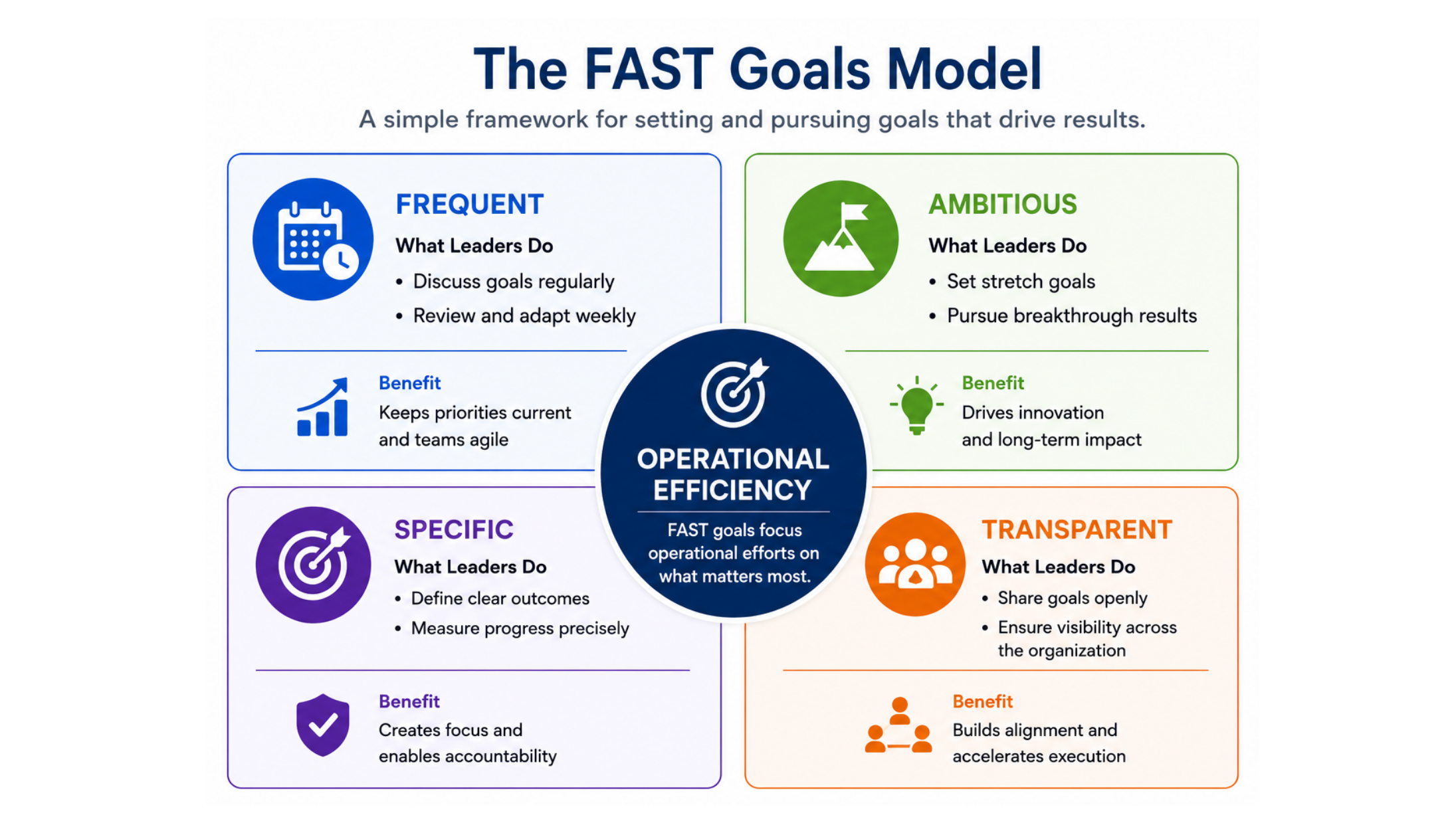
Whenever a significant operational improvement is completed, leaders should ask two questions:
- How has this improvement increased our ability to execute strategy?
- Which strategic priority is now easier to achieve because of it?
These questions ensure Operational Efficiency remains connected to enterprise priorities instead of becoming an isolated technology objective.
TBM strengthens this process by making the results of Operational Efficiency visible across the enterprise. Connected financial, operational, and business information allows leaders to understand where operational improvements have reduced friction, increased flexibility, or released resources that support future initiatives. Use TBM reporting to demonstrate not only where Operational Efficiency has improved technology operations, but also how those improvements have strengthened the organization’s ability to execute its strategic priorities.
Success should therefore be measured by more than lower costs, improved utilization, or faster delivery. Expand Operational Efficiency scorecards to include measures that demonstrate increased organizational responsiveness—the organization’s ability to redirect people, investment, and leadership attention as priorities evolve. Operational Efficiency is valuable because it continually increases the organization’s ability to execute strategy, regardless of what that strategy becomes.
Technology will continue becoming more complex. Business priorities will continue evolving. Organizations that continually reconnect Operational Efficiency to changing strategic priorities will consistently adapt more quickly than those that treat it as a standalone technology objective. Make Operational Efficiency a standing topic in strategic planning discussions, ensuring that every major shift in organizational priorities is accompanied by an equally deliberate conversation about how technology operations can best enable it.
The next section demonstrates how organizations have applied these principles in practice, illustrating how Operational Efficiency has improved technology operations while strengthening broader business outcomes.
Operational Efficiency in Practice
If the preceding sections describe the management discipline of Operational Efficiency, these organizations demonstrate what that discipline looks like in practice. Operational Efficiency is not achieved through isolated optimization initiatives. It develops by understanding technology as a connected system, improving the quality of operational decisions, continuously refining the operating environment, sustaining those improvements through organizational alignment, and ensuring they remain aligned with evolving business priorities.
The experiences of organizations practicing TBM show that this progression is remarkably consistent. Although their industries, technologies, and business objectives differ, they repeatedly adopted the same management disciplines. The operational initiatives varied, but the management disciplines remained remarkably consistent.
National Grid illustrates this progression during a large-scale technology transformation. Rather than treating application rationalization, cloud optimization, network management, and technical debt reduction as independent projects, leaders developed a connected understanding of technology operations that allowed decisions to be evaluated across the broader operating environment. Operational Efficiency became a continuous management discipline rather than a series of disconnected optimization efforts. The lesson is clear: evaluate major operational initiatives as part of the entire operating environment rather than as isolated optimization projects.
MassMutual demonstrates the same progression from a different starting point. By establishing a common technology taxonomy, consumption-based allocations, and integrated planning processes, the organization created a shared operational understanding across Technology, Finance, and business leadership. Operational decisions became more consistent because every stakeholder evaluated technology through the same management model. Shared operational understanding should precede significant operational improvement efforts, not follow them.
The executive perspective reinforces the same lesson. In TBM Might Have Saved My Job as CIO, Larry Godec explains how connected operational and financial transparency transformed executive conversations. Rather than defending technology budgets, leadership could evaluate investment trade-offs, discuss business outcomes, and continually align technology operations with changing enterprise priorities. Operational Efficiency had become an enterprise management capability rather than simply an internal IT objective. Technology leaders should therefore frame Operational Efficiency in terms of business outcomes rather than technology spending.
Viewed together, these organizations reveal the same progression described throughout this paper. Each first established a connected understanding of technology operations. They then improved operational decision-making, embedded Operational Efficiency into routine management practices, and continually aligned technology operations with evolving business priorities. Different organizations pursued different initiatives, but they followed remarkably similar management disciplines.
| Organization | Challenge | Management Response | Business Outcome |
| National Grid | Large-scale technology transformation across a complex technology environment | Connected financial, operational, and benchmarking information into a common management view that supported continuous operational improvement | Technology decisions became more coordinated, enabling sustained optimization across applications, cloud, networks, and technical debt as part of a broader transformation. |
| MassMutual | Limited visibility into technology costs, consumption, and planning | Established a common technology taxonomy, consumption-based cost model, and integrated planning processes that created a shared operational understanding | Greater transparency, stronger business trust, improved planning, and more informed technology investment decisions. |
| Executive Perspective (Larry Godec) | Difficulty communicating technology value and prioritizing investments | Connected operational and financial transparency to executive decision-making and business outcomes | Technology conversations shifted from defending budgets to making better strategic investment decisions. |
The value of these examples lies less in the specific initiatives each organization pursued than in the management disciplines they consistently applied. Technology leaders should focus on adopting those disciplines within their own organizations.
- Evaluate major technology initiatives as part of an interconnected operating system rather than in isolation.
- Establish a shared operational understanding before expecting consistent operational decisions across Technology, Finance, and the business.
- Review Operational Efficiency continuously rather than only during annual planning or transformation initiatives.
- Approve operational improvements only when they strengthen organizational alignment.
- Reconnect Operational Efficiency to enterprise priorities whenever those priorities evolve.
Organizations do not achieve Operational Efficiency by copying another organization’s initiatives. They achieve it by consistently applying the same management disciplines. Operational Efficiency becomes repeatable because leaders repeatedly apply those disciplines—not because they pursue the same optimization projects.
Conclusion – Operational Efficiency Is a Leadership Discipline
Technology will continue becoming more interconnected. Artificial intelligence, cloud platforms, cybersecurity, digital products, and evolving business demands will only increase the complexity technology organizations must manage. The challenge facing future technology leaders is therefore not simply keeping pace with change—it is continually improving technology operations while change never stops.
This is why Operational Efficiency has become a defining leadership capability. It is not a cost-reduction program, a transformation initiative, or a one-time optimization effort. It is the discipline of continually improving how technology operates so the organization can continually improve how it executes its strategy.
Throughout this paper, one principle has remained consistent. Organizations improve Operational Efficiency by improving the quality of the decisions they make. They evaluate technology as a connected system. They establish a shared operational understanding across Technology, Finance, and the business. They continuously improve the operating environment rather than periodically optimizing it. They sustain those improvements through organizational alignment and continually reconnect Operational Efficiency to evolving strategic priorities. Effective TBM practices provide the management system that enables those disciplines to become part of everyday leadership rather than isolated transformation efforts.
The implication for technology leaders is straightforward. Do not ask whether your organization is operationally efficient. Ask whether your management practices consistently produce better operational decisions than they did six months ago. If they do, Operational Efficiency is improving. If they do not, additional optimization initiatives are unlikely to create lasting change until the management discipline itself improves.
Ultimately, Operational Efficiency should not be measured by how much cost has been removed from the technology organization. It should be measured by how much better the organization has become at operating technology, adapting to complexity, and redirecting newly created capacity toward the priorities that matter most.
Organizations that develop this capability gain something far more valuable than lower operating costs. They gain the ability to adapt with confidence. Every operational improvement makes the next decision better informed. Every better decision strengthens the operating environment. Every improvement creates capacity that can be reinvested in innovation, resilience, modernization, customer experience, or whatever strategic priorities emerge next.
Technology will never stop changing.
Organizations that treat Operational Efficiency as a continuous management discipline will not simply keep up with that change—they will be positioned to lead through it.


