The CFO’s Guide to the TBM Taxonomy

Governing technology as a financial investment

Abstract

Technology is no longer a back-office support function—it is the engine of enterprise growth, innovation, and resilience. Yet, as digital investments rapidly expand across public cloud, artificial intelligence, and agile product delivery, finance leaders frequently struggle to answer fundamental questions with confidence: What are we actually spending? Are these investments yielding defensible ROI? And how do we transition technology from a cost center into a strategic value driver?

The Technology Business Management (TBM) Taxonomy 5.0 provides the standard financial language required to answer those questions. It establishes structural transparency across cost pools, resources, solutions, and consumers, enabling traceability from general ledger inputs to business outcomes. This article explains how finance leaders can leverage the TBM Taxonomy 5.0 to optimize unit economics, improve forecasting, and govern technology as a disciplined investment portfolio.

The New Finance Mandate: From Cost Control to Value Realization

Technology spending has never been more essential, or more heavily scrutinized. Global technology spending continues to rise, surpassing $5 trillion annually, and boards now expect defensible ROI and precise financial performance from these investments. However, the structural complexity of the modern enterprise has intensified: cloud consumption fluctuates dynamically, AI introduces unprecedented cost structures, and persistent Agile teams disrupt traditional capital versus operating expense (CapEx/OpEx) accounting.

Under these conditions, the mandate for the modern financial leader has fundamentally evolved. It is no longer sufficient to simply govern the technology budget and track variances. The modern finance leader must empower faster decision-making, evaluate complex scenarios, and execute strategic trade-offs across the portfolio to bridge the gap between traditional financial management practices and enterprise-wide value modeling.

Yet, persistent structural challenges stand in the way:

  • An inability to connect technology commitments to business consumption and outcomes.
  • Fragmented reporting across the General Ledger, FinOps tools, and service management systems.
  • Volatile cloud costs and opaque, escalating Artificial Intelligence investments.
  • Difficulty capitalizing labor as organizations shift from project timecards to persistent Agile product teams.

These challenges stem from inconsistent definitions and disconnected systems of record. When the General Ledger cannot easily translate into business capabilities, conversations devolve into debates about whose numbers are correct. The TBM Taxonomy resolves this fragmentation by providing a shared structural vocabulary that aligns Finance, Technology, and the business around measurable financial performance.

Recommended Read: For deeper insights into merging traditional finance with value-driven technology management, read From Cost to Value – Integrating ITFM into the TBM Journey.

The Architecture of Technology Value: Framework, Taxonomy, and Model

Before examining the Taxonomy, it is essential to understand the broader system in which it operates. Sustainable value management requires institutional design, not episodic spreadsheet exercises. TBM operates through three interdependent constructs:
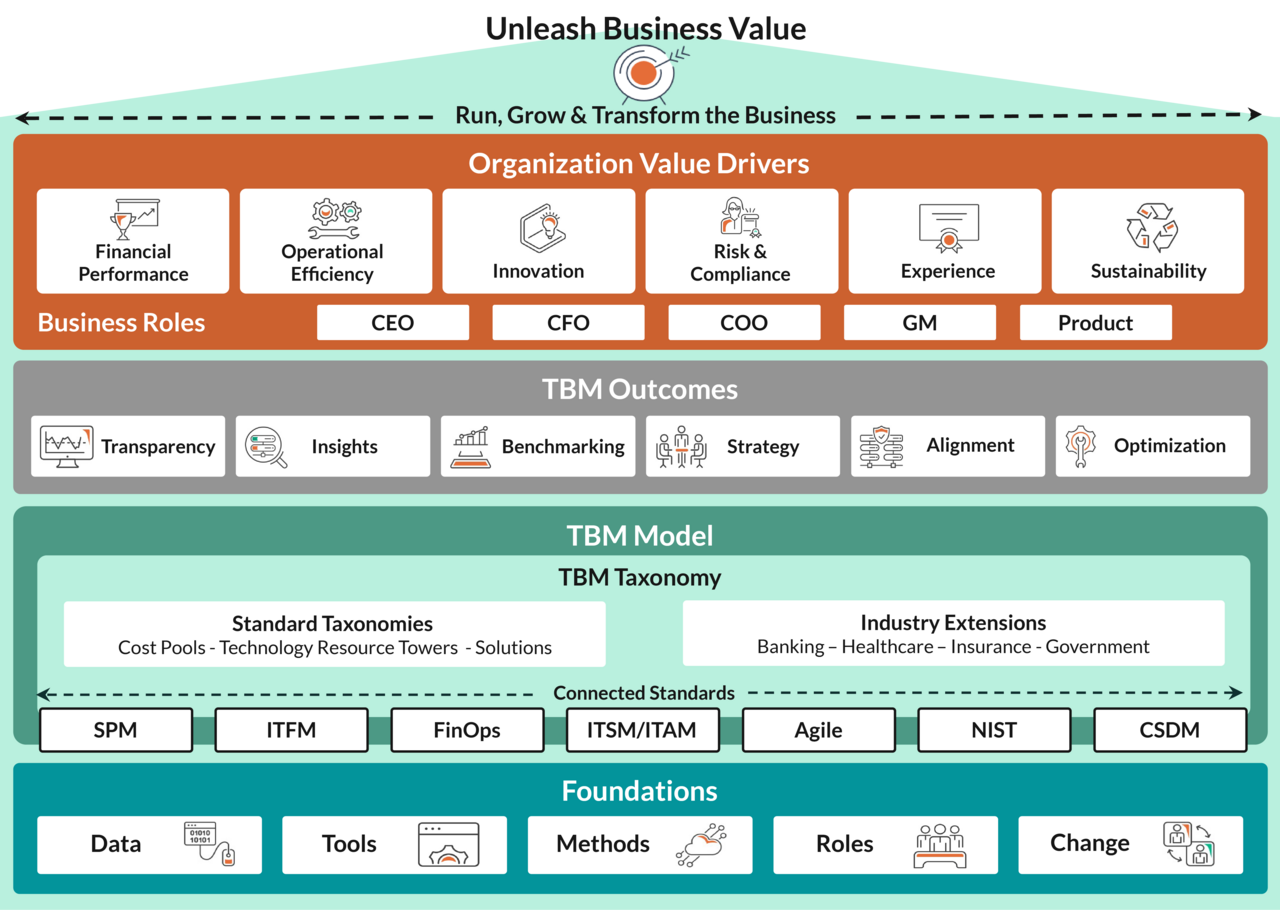
  1. The TBM Framework is the governing architecture. It institutionalizes technology value management as an enterprise operating model, establishing the foundational capabilities (data, tools, methods, roles, change) and defining Organizational Value Drivers—such as Financial Performance and Operational Efficiency.
  2. The TBM Taxonomy is the standardized classification system. It defines the structural vocabulary for organizing technology cost, resources, solutions, and consumers, answering the question: How should we consistently describe the financial components of our technology estate?.
  3. The TBM Model is the computational and analytical heart of the framework. It applies the Taxonomy’s classification system to enterprise data, integrating financial inputs, operational drivers, and allocation logic to produce decision-ready intelligence like unit costs and Total Cost of Ownership (TCO).
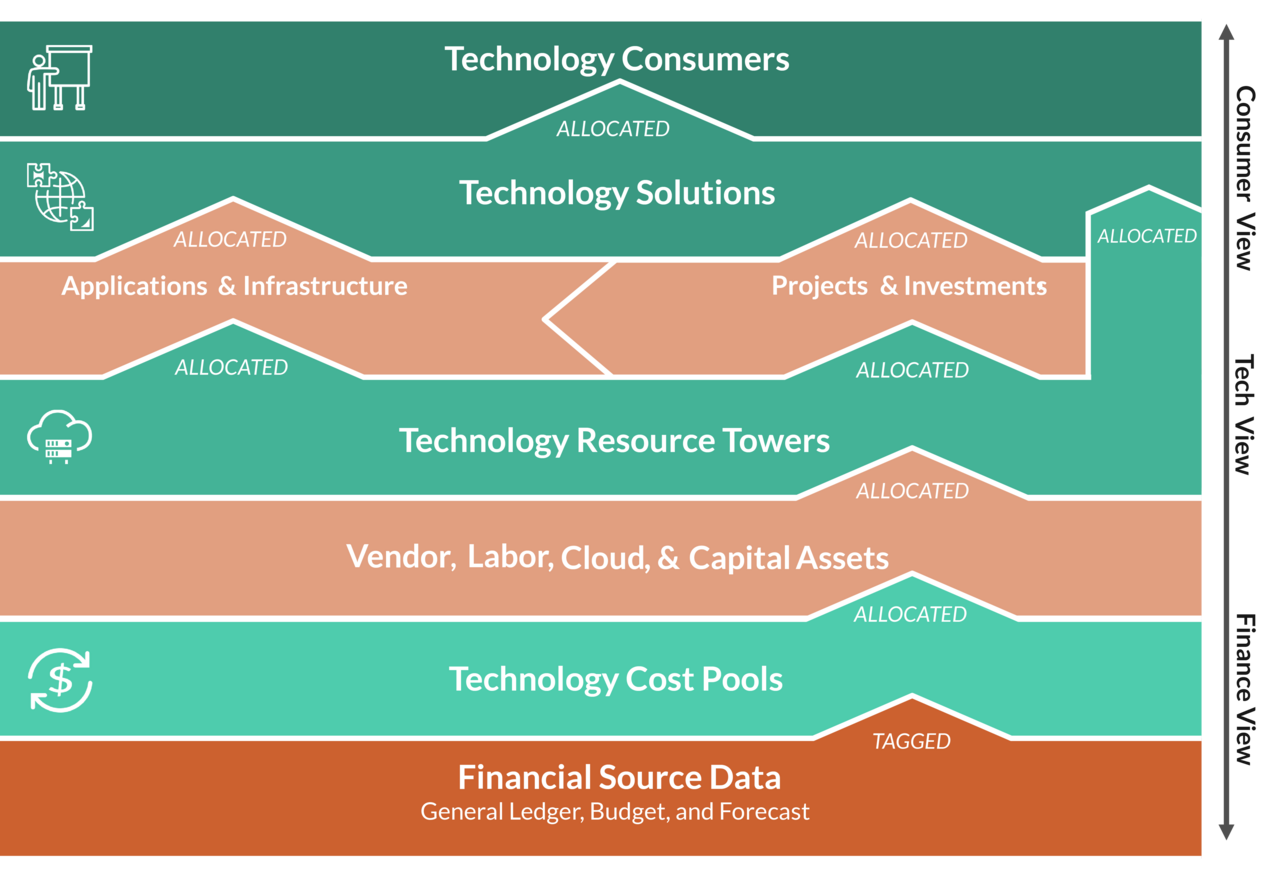
For the CFO, the distinction is critical: The Framework governs the financial discipline, the Taxonomy defines the structural language, and the Model converts that language into executive intelligence.

Recommended Read: To see how tracing demand through this model replaces spreadsheet-driven guesswork with clear variance analysis, read The Technology Finance Leader – Applying TBM to Modern Planning & Forecasting.

The TBM Taxonomy 5.0: The Financial Foundation
Why does Finance need an alternate view of the Chart of Accounts? Because General Ledger and financial ERP systems alone cannot provide technology leaders with the context required to manage costs effectively. Finance speaks the language of accounting—depreciation, software licensing, and hardware assets—while Technology communicates in services, products, and capabilities. This disconnect prevents Finance from seeing the true cost of delivering business value.

For a CFO, understanding the TBM Taxonomy is not an academic exercise in categorization; it is a vital mechanism to de-risk the enterprise, accelerate positive business impacts, and produce actionable financial outcomes faster.

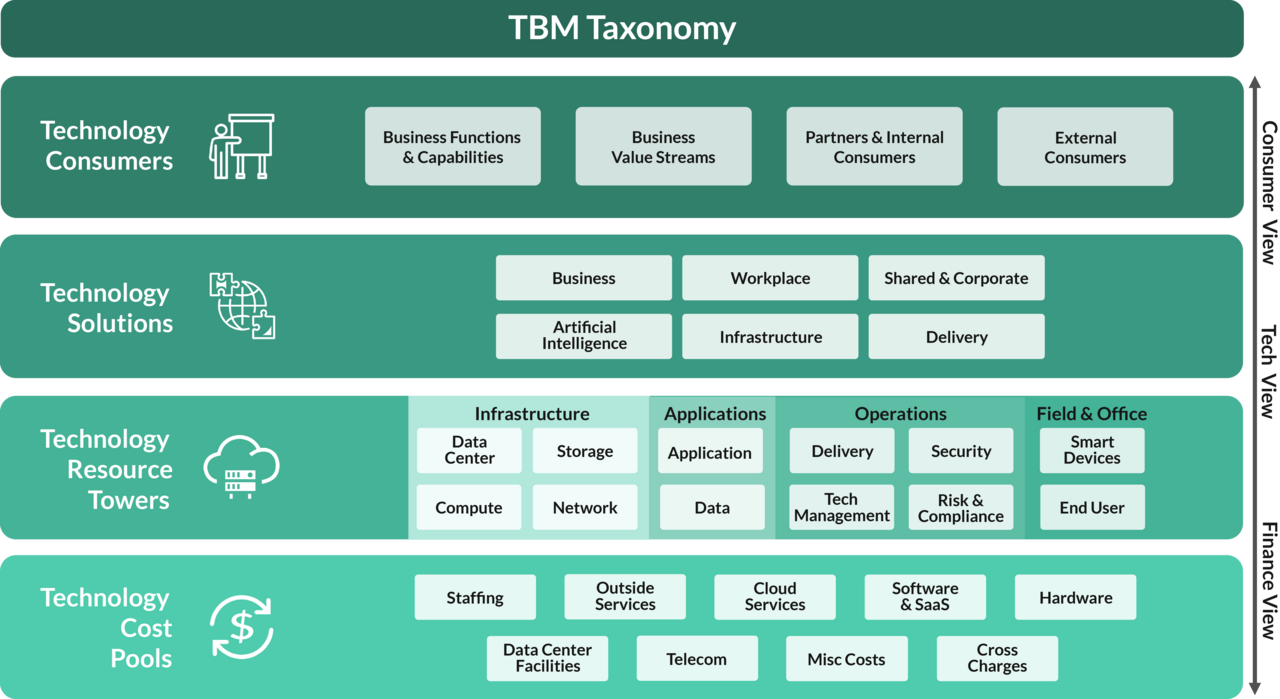
The Taxonomy is organized into four interconnected layers that trace every dollar from financial input to business beneficiary. For a comprehensive breakdown, read the official TBM Taxonomy Version 5.0.1 whitepaper.

  1. Technology Cost Pools: Where Investment Begins This layer categorizes technology spend into standardized groups based on what was purchased, mapping directly to the General Ledger to ensure foundational financial predictability. It distinctly separates operating and capital expenditures across categories like Labor, Cloud Services, Software & SaaS, and Hardware. This allows the CFO to consistently halt “shadow IT” and answer exactly how much of the estate is fixed versus variable.
  2. Technology Resource Towers: How Technology is Structured If Cost Pools explain where money originates, Resource Towers explain how technology capabilities are functionally organized (e.g., Compute, Storage, Application, Security). For Finance, Towers are where benchmarking becomes possible. CFOs can consistently analyze labor intensity and infrastructure ratios against industry peers to identify structural inefficiencies.
  3. Technology Solutions: What Technology Delivers This layer represents the platforms and capabilities the Technology organization delivers to the business (e.g., Business Solutions, Workplace Solutions, AI Solutions). Solutions enable CFOs to understand the fully burdened Total Cost of Ownership (TCO), transitioning funding models from episodic projects to continuous business capabilities.
  4. Technology Consumers: Who Benefits from Technology The top layer identifies the stakeholders—whether business units, value streams, or external customers—that determine business value. For the CFO, this layer is crucial for evaluating the structural investments of the technology organization. By mapping costs to consumers, finance leaders can assess whether the organization is operating primarily as a heavy infrastructure shop or a product development engine. It provides the transparency needed to determine if certain functions are overly reliant on outsourcing, or if administrative overhead is disproportionately high. Ultimately, this connects delivered services to consumers, allowing CFOs to implement defensible showback or chargeback models.

A Single Source of Truth: Role-Based Views

While the four layers of the taxonomy create a unified structural foundation, executives across the enterprise evaluate technology differently. To accommodate this, the taxonomy is intentionally designed with contextual perspectives known as Views.

Views are not alternative taxonomies; they are validated lenses through which the taxonomy is interpreted to support specific responsibilities. For example, the Business View highlights solutions and consumers to evaluate value delivery, while the Technology View emphasizes resource towers and solutions to support service management and optimization.

For the CFO, the Finance View focuses predominantly on Cost Pools and Resource Towers. It supports budgeting, planning, variance tracking, and accurate chargeback models without fragmenting the underlying logic used by the CIO or business leaders. Through these shared Views, the CFO establishes a single source of truth, eliminating the “multiple versions of the truth” problem that undermines executive trust.

The Taxonomy in Action: Strategic Financial Use Cases

Without a shared structural language, financial data, operational metrics, and business outcomes remain disconnected. When these domains exist in silos, organizations struggle to manage technology spend as a true investment, resulting in poor capital allocation, limited accountability, and low confidence in ROI.

When applied together, the taxonomy layers solve these persistent pain points, empowering the CFO to make strategic business trade-offs rather than simply enforcing cost controls.

Executing Strategic Trade-offs (Run vs. Grow) While cost control and budget variance are table stakes, the modern CFO must actively manage trade-offs between legacy maintenance and new innovation.

  • Real-World Value: American Express used TBM to gain deep financial transparency, enabling them to reduce run costs and improve budget predictability. This visibility empowered executives to execute a massive strategic trade-off: they reduced operating expenses by a 4% CAGR, unlocking $300M annually to reinvest into growth-driving digital initiatives, agile engineering, and product updates like the Platinum Card refresh.

Enabling Showback/Chargeback & Eliminating Stranded Costs CFOs need to recover costs and identify stranded costs during mergers, acquisitions, or divestitures.

  • Real-World Value: MassMutual utilized the TBM Taxonomy to standardize allocations across applications and business services. This granular transparency enabled them to accurately price Transition Services Agreements (TSAs) during a massive divestiture, successfully eliminating $75M in direct and stranded costs within 100 days.
Recommended Read: To learn how to execute fast, defensible estimates during complex transactions to eliminate stranded costs, review Navigating Mergers, Acquisitions, and Divestitures with TBM.

Governing the Modern Estate: Cloud and AI

To govern the modern technology estate, CFOs must be able to accurately forecast and govern rapidly scaling cloud and Artificial Intelligence investments. The TBM Taxonomy directly addresses the realities of these dynamic environments.

  1. Modeling the True TCO and Business Outcomes of AI What makes AI cost drivers so different from traditional technology? Unlike standard software, AI investments are highly variable, blending specialized GPU infrastructure, massive unstructured data processing, continuous model training, and premium talent. However, these investments also produce profound business outcomes—from predictive market analytics and autonomous customer service to accelerated product development.

The taxonomy recognizes AI as a distinct investment category. It includes dedicated domains such as AI Compute, AI Models, and Generative AI Solutions. This enables the CFO to model the true TCO of AI against its positive business impacts, ensuring investments are governed by value rather than runaway pilot costs.

Recommended Read: If you are struggling to forecast new AI investments and establish risk controls, utilize the executive guide, TBM for AI Value Realization.
  1. Bridging FinOps and Financial Management via Cloud Transparency Public cloud adoption introduces a level of cost variability that traditional financial management practices were not built to handle. Finance leaders require the ability to predict and control variable cloud expenses while clearly understanding the underlying consumption drivers. Furthermore, CFOs need reliable decision support to conduct scenario analyses—evaluating the financial trade-offs between on-premises infrastructure and public cloud environments—to optimize the operating model for maximum business impact.

To support this, the taxonomy utilizes a dedicated Cloud Services Cost Pool. This isolates cloud spend, acting as the bridge between FinOps (engineering-led, real-time optimization) and financial management (finance-led, monthly forecasting). By contextualizing cloud spend alongside fixed on-premise data center costs, the CFO can model hybrid scenarios, manage variability, and execute intelligent workload placement strategies.

Recommended Read: To better navigate variable cloud spending and scenario modeling for workload placement, review The Cloud Reality Check: Driving Intelligent and Sustainable Cloud Strategies.

The CFO’s Next Steps: Moving from Cost to Value

The value of the TBM Taxonomy 5.0 depends on whether it remains a reference document or becomes an organizational financial norm. Finance leaders can take immediate steps to embed this standard.

  • Formalize the CFO of Technology Role: Establish the finance leader as a strategic partner to the CIO. Utilize the Mastering the Role: CFO of IT Competencies in the Digital Era guide to define competencies around investment management and value optimization, moving beyond traditional controllership.
  • Normalize Financial Data: Compare your current Chart of Accounts and budget structures to the taxonomy definitions. Identifying inconsistencies and mapping raw financial records to standard Cost Pools is the required first step toward accurate variance tracking and defensible cost transparency.
  • Build Strategic Alignment (Your Next Step): Initiate a strategic alignment meeting between Technology and Finance to establish a shared “Bill of IT.” Focus on quick wins, such as mapping existing General Ledger categories to standard Cost Pools, before attempting complex chargeback models. For actionable guidance on bridging this gap, your immediate next step should be to read the TBM First Steps Guide: Building Strategic Alignment Between IT and Finance.
  • Accelerate Adoption: To help your TBM Office secure quick wins, navigate cultural resistance, and maintain stakeholder momentum, review the Top Five Best Practices for Successful TBM Adoption.

Conclusion

For finance leaders operating in environments shaped by cloud volatility, AI expansion, and Agile funding, structural consistency is the foundation of effective investment governance. The TBM Taxonomy 5.0 provides the disciplined, industry-backed vocabulary required to translate fragmented General Ledger data into strategic advantage. By standardizing how technology costs are categorized and consumed, the financial leader can elevate their role from budget enforcer to strategic partner, driving measurable financial performance, risk mitigation, and enterprise value.

Red Hat built the world’s largest enterprise open-source software company, growing into a multi-billion-dollar firm before being acquired by IBM Corp. This open-source heritage often placed the value of technology in the product and engineering realm rather than with IT. Thus, not surprisingly, Red Hat’s TBM journey started with a new CFO wanting to know why IT costs were so high. Through the TBM framework and discipline, Red Hat IT successfully delivered cost transparency of all IT spend and then became a model for technology spend planning and forecasting. The IT team added the FinOps discipline to its capabilities and is now managing a broad hybrid cloud portfolio. However, TBM and FinOps have remained in the realm of IT only, until now. Red Hat’s current CIO, Jim Palermo, is driving TBM, FinOps, and Enterprise Agile Management across the company based on IT’s success and through the lens of value stream management. in this session, Jim will walk through Red Hat’s TBM journey and its current transformation to an operational business architecture framework built on value streams aligned to business outcomes.


Speaker:

  • Jim Palermo, VP, CIO, Red Hat

When the team at Tenet Healthcare made the decision to move towards a model that provided more accurate financial transparency, they looked to TBM practices and solutions. Join Paola Arbour, EVP and CIO at Tenet healthcare as she answers the question “why TBM?”, including what Tenet was trying to solve with the TBM Taxonomy, the effectiveness of their KPIs, and how building support and momentum across the entire company was critical to their successful TBM adoption. In this session, Paola will also share how Tenet continues to evolve their use of TBM, including for mergers, acquisitions, and divestiture activity, as well as segmenting cost structures.


Speaker:

  • Paola Arbour, EVP & CIO, Tenet Healthcare

Data driven decision making has been a key to longevity and delivering best in class service to State Farm’s customers over the past 100 years. Recently, State Farm decided to use a managed services company for the day-to-day support of their Infrastructure Services. Today’s technology leaders need to be able to make real-time, informed decisions to help ensure technology investments are meeting their customer’s needs, while continuing to support company long-term goals. Ashley Pettit, SVP & CIO at State Farm, will be joined by Randy McBeath, Enterprise Technology Executive, and Andy Moore, Technology Director, and together they will share how TBM aided in State Farm’s analysis and decision to move to a managed service provider.


Speakers:

  • Ashley Pettit, SVP & CIO, State Farm Insurance
  • Andy Moore, Technology Director, State Farm Insurance
  • Randy McBeath, Enterprise Technology Executive, State Farm Insurance

There is fast evolution occurring in the overall technology spend and value management market, with the advancements of cloud, Kubernetes, AI/ML, and other innovations. At the same time, we are seeing vast changes in the roles of the CIO, CFO, and business/digital leadership. In addition, TBM is intersecting with other disciplines and frameworks, such as Cloud FinOps, Agile engineering, and portfolio resource management. How is this affecting the TBM discipline, the TBM Council, and Apptio? For one, TBM is moving down market, becoming more accessible to all sizes and maturity of organizations, with easier ways to get started and a faster time to value. Cloud FinOps, meanwhile, is advancing and adding capabilities previously in TBM to the cloud cost management space. Join Apptio CEO Sunny Gupta as he explores the evolving TBM landscape and how he believes it will bring even greater opportunity and value to organizations worldwide.


Speaker:

  • Sunny Gupta, Co-Founder & CEO, Apptio

In today’s challenging economic times it is critical that CFOs, CIOs, and CTOs speak the same language when it comes to the value of technology spend. Having a single source of truth that everyone can feel confident in, track progress continuously throughout the year with shared insights, and analyzing options for resourcing and funding in order to reduce waste is where TBM deepens their partnership. In this discussion, join members of the TBM Council Board of Directors as they discuss the pivotal conversations and steps taken to collectively adopt TBM practices across the organization, including responding to naysayers and gaining allies.


Panelists:

  • George Maddaloni, EVP, CTO, Operations, Mastercard
  • Laura Walsh, CIO, Smithfield Foods
  • RJ Hazra, SVP & CFO, Technology & Security, Equifax
  • Moderated by Chad Doiran, Managing Director, Tech. Strategy & Advisory, Accenture

Fumbi Chima has led technology teams across multiple organizations throughout her esteemed career, including retail, manufacturing, media, and financial services. As a turnaround and high growth leader, Fumbi has leveraged TBM as a foundational practice to bring repeatable processes, purchasing guidelines, and cost/resource savings. Now at Boeing Employe Credit Union (BECU) serving more than 1.2 million members, Fumbi is driving their digital transformation with a clear vision and strategy to optimize their public-cloud with TBM and Cloud-FinOps, adopt a product model, and set the groundwork for future innovation and growth. Join Fumbi and Larry Blasko, President, Field Operations at Apptio, as they discuss the lessons Fumbi has learned along her TBM journey, and where this transformation leader sees the evolution of TBM taking the Technology industry.


Speakers:

  • Fumbi Chima, Chief Technology & Transformation Officer, BECU
  • Larry Blasko, President, Field Operations, Apptio

Technology leaders have a unique opportunity to transform their organizations into environmental champions with sustainable business practices. In this session, Neal Ramasamy, CIO at Cognizant and Phil Alfano, Field CTO at Apptio will share how TBM can be leveraged to achieve comprehensive visibility into real-time data-driven tracking to ensure company goals and actions are being met to achieve a sustainable future.


Speakers:

  • Neal Ramasamy, CIO, Cognizant
  • Phil Alfano, Field CTO, Apptio

For McGraw Hill, having a transparent framework that drives smart investment strategies and a common language across this 135-year-old company is critical. Known as one of the “big three” education publishers, McGraw Hill must stay ahead of their competitors with innovation and value delivery. Join Yuliya Oberman, Finance Director for McGraw Hill Education and Eileen Wade, General Manager of the TBM Council as they discuss how TBM is essential to McGraw Hill’s enterprise resource strategies and digital transformation journey.


Speakers:

  • Yuliya Oberman, Finance Director, McGraw Hill Education
  • Eileen Wade, General Manager, TBM Council

In this fireside chat, Matt Yanchyshyn, GM, AWS Marketplace & Partner Engineer at AWS will join incoming General Manager of the TBM Council, Jack Bischof, for a discussion on best practices for building successful TBM practices focused on cloud financial management. Including a deep dive into the nuances, learnings, and milestones that the world’s 9th largest insurance company is achieving on their Cloud FinOps journey.


Speakers:

  • Matt Yanchyshyn, GM, AWS Marketplace & Partner Engineering, AWS
  • Jack Bischof, Incoming General Manager, TBM Council

Hear from Ajay Patel, COO at Apptio and Zubin Irani, CEO at Cprime as they discuss how the intersection of TBM and enterprise agile planning is a critical strategy for organizations to adopt if they want to drive business growth more efficiently, in real-time, and keep up with the speed of change that today’s organizations face.


Speakers:

  • Ajay Patel, COO, Apptio
  • Zubin Irani, CEO, Cprime

Join Origin Energy’s Adrian Thivy, GM, Enterprise Technology Services, as he shares how TBM is creating complete confidence in their spend-to-value ratios across IT and the broader company, allowing a rapid response to the market forces driving significant pressure on the “cost to serve” customers. A finalist for the 2022 TBM Council Award for TBM Pacesetter, hear how their TBM practice was built in record time, including lessons learned as they developed business capabilities and managed a significant cloud migration and transformation.  

Session topics will include:  

  • Establishing a clear purpose and common goals that drive cross-functional understanding
  • Utilizing an adaptative governance framework to ensure accountability across all stakeholders 
  • Leveraging TBM and ServiceNow CSDM to deliver a transparent, flexible, and sustainable model in a shorter time frame
  • How bespoke logic has dramatically improved transparency of cost more than 90%


Presented by:

  • Adrian Thivy, GM, Enterprise Technology Services, Origin Energy 

Many organizations aspire for a cloud-native posture, however few have the time, resources and budget to transform into 100% public cloud operations. Equifax has broken through those barriers to modernize its infrastructure globally — driving faster innovation for customers, more business agility, and stronger cybersecurity. Hear from Manav Doshi, GM, Technology Solutions on how the Equifax team is rebuilding a century-old company, with a real-time approach to optimizing cost and revenue growth in the cloud.


Presented by:

  • Manav Doshi, GM, Technology Solutions, Equifax 

Transport for NSW is the winner of the 2022 TBM Council Award for TBM Pacesetter, which recognizes significant progress and value with TBM in a relatively short period of time. In this session, hear how the merger of Roads and Maritime Services (RMS) and Transport for New South Wales resulted in the fastest consolidation of TBM data, models, and reports into a single TBM practice. Hear from Poonam Kataria, Sr. Manager of TBM, as she shares how TBM is driving Transport’s three key strategic outcomes: connecting a customer’s whole life; successful places for communities; and enabling economic activity.

Session topics will include: 

  • Utilizing the TBM Taxonomy to align M&A practices and drive behavioural change 
  • How the right level of support sets the right culture and TBM processes
  • Driving change in the organization based on data-driven facts

Presented by: 

  • Poonam Kataria, Sr. Manager, TBM, Transport for NSW 

Discuss how TBM supports visibility of investments across the enterprise to support setting best practices and standards for managing the impact of environmental, societal, and governance strategies by IT departments and organizations.

The TBM Council Standards Committee has built out TBM integration models with other IT disciplines, including Enterprise Agile and Product Thinking, as well as ServiceNow CSDM. Current findings will be shared to drive group discussion, experience, and feedback. 

Public cloud strategies are often embraced for the promise of rapid scalability, on-demand agility, and best-in-class security, resiliency, and features. However, public cloud adoption presents significant financial challenges that, when not addressed, inhibit any firm’s ability to exploit the promises of public cloud.  

To address these challenges, customers need to simultaneously resolve current inefficiencies and build capability to ensure avoidance of waste in the long term.  

In this session we discuss a detailed framework combining TBM-Cloud with FinOps, allowing customers to understand how to implement a program to overcome these challenges and financially succeed in the cloud. 

Session discussion topics include: 

  • A detailed view of the activities required to implement a TBM-Cloud with FinOps Journey 
  • Detail the flow of information required for each task 
  • Provide guidance on which activities should be performed when


Presented by:

  • Nathan Besh, TBM-Cloud Evangelist, TBM Council 

Project to Product Transition

Outcome-focused development via agile transformation

For organizations looking to transition from projects to products, TBM can help organize resources and outcomes into value streams – the specific sets of activities that align to business outcomes.

Accelerating Cloud Adoption

Drive measurable outcomes with your cloud strategy

For organizations trying to accelerate their cloud journey, TBM provides a way to map a plan and measure the outcomes from cloud migration to cloud cost management to cloud optimization.

Morning Sessions

A look back at 10 years of TBM leadership and community building.


Speaker:

  • Ashley Pettit, SVP & CIO, State Farm Insurance

Introduced more than 10 years ago, Technology Business Management (TBM) was born out of the need for CIOs to have a management system to drive their technology operating strategy. At its core, the TBM discipline gives visibility into technology spend to provide common ground and enable a collaborative partnership across teams for prioritizing resources and achieving business outcomes. In this session, the TBM Council Standards Committee Chair, Atticus Tyson will share how over the past few years TBM has evolved to ensure leaders are able to accelerate digital initiatives, embrace the cloud, and communicate today’s complex technology landscape. TBM enables organizations to frequently and quickly evaluate projects, platforms, and investments to address the needs of the modern enterprise.


Speaker:

  • Atticus Tysen, SVP Product Development, Chief Information Security & Fraud Prevention Officer, Intuit

Atticus Tyson and Phil Alfano will guide the group through an executive discussion to capture “What is digital success to you?”. Is it how your organization creates new business capabilities? The elimination of legacy processes and systems? Funding innovation? Or all of the above as long as it drives an improved customer experience? Discuss with your table mates, as an overall group, and capture learnings and takeaways to bring back to your own team.


Speakers:

  • Atticus Tyson, SVP Product Development, Chief Information Security & Fraud Prevention Officer, Intuit
  • Phil Alfano, Field CTO, Apptio

How does a 170-year-old financial institution deliver a new, fully modernized technology strategy while supporting 24×7 service to their customers across a multitude of platforms, including point-of-sale, mobile, and web services? Mike Brady, Nicole Holmes, and Chad Schmidt will share how at Wells Fargo, they are creating a Technology Infrastructure team founded in the TBM discipline and responsible for aligning with internal partners to adopt an automation first approach for accelerating the delivery of services and deploying enhancements at speed. All while remaining compliant, secure, and agile.


Speakers:

  • Mike Brady, EVP, Technology Infrastructure, Wells Fargo
  • Nicole Holmes, EVP, CFO for Technology, Wells Fargo
  • Chad Schmidt, SVP, Technology Finance Modernization, Wells Fargo

It’s been two years since the World Health Organization declared Covid-19 a global pandemic. To re-imagine employee and customer experiences, every company was forced to speed up their shift to digital from multi-year project plans to instead creating, executing, and delivering new business models in a matter of weeks. As we emerge from this crisis, we recognize this shift is not slowing down but exponentially increasing as businesses continue to respond to societal expectations of anytime, anywhere. In this session, Sunny Gupta will share how the companies best positioned to quickly respond to changing market conditions and hyper competition have a holistic view of their technology spend so they can be agile in their investment decisions, use the cloud as a competitive advantage, and align their resources to product delivery models and continuously measure value.


Speaker:

  • Sunny Gupta, Co-Founder & CEO, Apptio

Afternoon Sessions

Spinning up a cloud-native posture is a desired strategy for many organizations, however few have the time, resources, and budget to achieve 100% public cloud operations. In 2018, Equifax set a 5-year goal to achieve this, striving to provide their customers with faster innovation, more flexible business agility, and stronger cybersecurity. Hear from RJ Hazra, SVP & CFO, Technology on the lessons and successes the Equifax team has found along their journey, and what remains as they cross into their final year of their company-wide digital transformation.


Speaker:

  • RJ Hazra, SVP & CFO, Technology & Security, Equifax

The cloud is a significant shift in computing and companies need to get maximum value from it. FinOps is the evolving cloud financial management practice that empowers organizations to track and maximize cloud spend and enable tech, finance, and business teams to collaborate on data-driven spending decisions. In this talk, J.R. Storment, Executive Director of the FinOps Foundation will explore the intersection between TBM and the FinOps practice and the benefits achieved. Session discussion topics include: 

  • Creating a culture of ownership over cloud usage and spend
  • The most important challenges to tackle for delivering products faster while gaining financial control and predictability
  • FinOps organization structures in large and small organizations from the State of FinOps 2022 report


Speaker:

    • J.R. Storment, Executive Director, FinOps Foundation

In this engaging conversation, executive leaders will share both the challenges and best practices realized on their journey to embrace product-based innovation.

Session discussion topics include:

  • Achieving results as you shift from a projects-to-products innovation model
  • Maximizing CIO/CFO partnerships in this new paradigm
  • Building your innovation strategy around value streams, stable teams, and a high degree of customer centricity

Speakers:

  • John Wilson, VP, IT Costing & Performance Management, MetLife
  • Kaarina Bourquin, Director, Strategy & Portfolio Operations & Technology, The Standard
  • Moderated by Toyan Espeut, Chief Customer Officer, Apptio

Session abstract coming soon


Speakers:

    • Brendan Kinkade, VP, Build ISV, Technology & Hybrid Cloud, IBM
    • Moderated by Phil Alfano, Field CTO, Apptio Foundation

TBM empowers hundreds of decision makers with the facts they need to execute a digital strategy faster, without bias, and in alignment across business units. This includes technology consumers, service and application owners, LOB CIOs, enterprise PMOs, compliance leaders, budget coordinators, and many more. What are the fundamentals of developing and executing a successful TBM practice? In this session, experienced practitioners will share the lessons and foundations they’ve learned delivering business value for their organizations with TBM.

Session discussion topics include:

  • Fundamentals of proper support and sponsorship across key stakeholders
  • Demonstrating how and why TBM is core to strategy and a digital operating model
  • Developing, educating, and enabling your core team
  • Implementing or enhancing the necessary TBM processes

Speakers:

    • Jeri Koester, CIO, Marshfield Clinic Health System
    • Latrise Brissett, Managing Director, Global IT, Accenture
    • Leslie Scott, VP & CIO, IT Enterprise Services, Stanley Black & Decker
    • Moderated by Jason Byrd, Managing Director, Technology Strategy & Advisory, Accenture